
Food and Drink

by Kathleen Pokrud

Photo by ALMA and The Food School

Foreword by H.E. Ambassador Lorenzo Galanti

The Embassy of Italy

Italian cuisine - on which the Mediterranean diet is widely based - is meant as part of a healthy lifestyle. Natural ingredients are transformed into exquisite dishes while preserving and exalting their unique taste, based on a solid tradition and on constant innovation and research. Italian culinary culture begins in fact at the farm, among the olive trees and the tomato plants. It is somewhat a consequence of its inputs -authentic Italian ingredients and products, combined and prepared for you by savant and caring hands wishing to convey their love for what they do. If food is a way to communicate, then Italian cuisine is the hallmark of conviviality, bringing people around the table to share a moment of sheer pleasure thanks to the passion and expertise the cook put into the preparation. For all these reasons, “la cucina italiana” enjoys wide popularity in a very food-conscious country like Thailand.

The opening in Bangkok of The Food School, with a section dedicated to Italian culinary arts, marks a dramatic change in the presence of Italian cuisine in Thailand. The project, which enjoys the active involvement of the School of Italian culinary arts ALMA, from the city of Parma, in Italy, will make it possible for all chefs interested in receiving first hand know-how from Italian instructors and chefs of authentic Italian cuisine. The Food School will also be open to food lovers for master classes from Italian chefs working in Italian restaurants in Thailand. Bangkok will thus become a regional hub for authentic Italian cuisine to be enjoyed everywhere: at the restaurant, and at home. Beware of imitations!

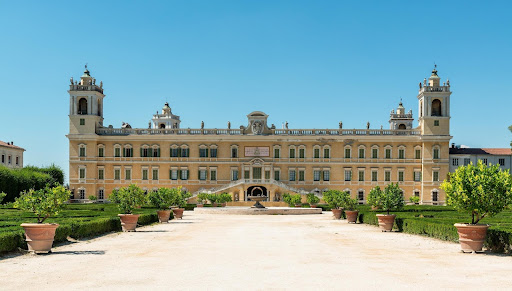
Staircase and skylight ceiling at The Food School Bangkok
Alma- The School of Italian Culinary Arts, Ducale Palace of Colorno

Our first discussion was on the history and Mr. De Rosa described, “The roots of Italian cuisine take us back into the history of our country. We are the result of the uninterrupted heritage left by the peoples who have inhabited our peninsula. Italian cuisine is not only that of the ancient Romans, but also Etruscan, Greek, Arab, Norman, Lombard and so on. It is a historical mix of incredible complexity. Italian cuisine is rich if it comes from the noble palaces, from the great Renaissance courts.  It is also a rural cuisine, poor and simple. Italian cuisine is based on farmer’s, shepherd’s, and fishermen’s culture. It is built on the diversity of raw materials bequeathed by the pages from history. These products are the fruit of the incredible geographical diversity that characterises our country. We can say that Italian cuisine is the cuisine of encounter and comparison. Food is the object of debates, entertainment, relationships, and dialogue. Therefore, cooking is a powerful form of self-expression. We always pay the utmost attention to everyday food. Eating becomes an instrument of relationship with others. The table is our favourite meeting place.”
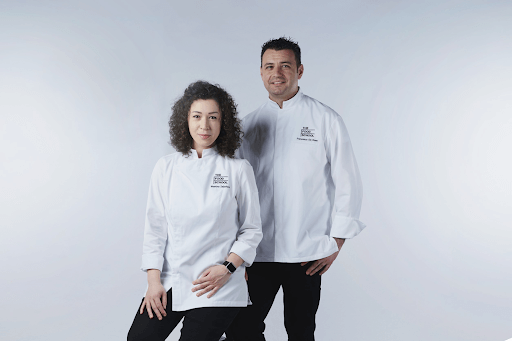
Chef Martina Sabbioni and Chef Francesco De Rosa

Regarding popularity in the world, Ms. Sabbioni revealed, “Cooking is a language that tells the country’s culture. Italian cuisine shows great strength in reaching the countries of the world. This strength goes hand in hand with the great success of Made in Italy. Italy has always been considered as an example in the field of art, craftsmanship, fashion, music, literature, and motors. Food could not be less important and well known. Today Italian food is a great expression of Made in Italy. The popularity of Italian cuisine starts from here, from the uniqueness of the raw materials to the wise way to respect them. Today Italy is in the top position in Europe for the number of products recognised by the EU as typical. The Italian biodiversity is perfectly described by the large number of local ingredients we use in our food culture.”

She further elaborated, “Italian cuisine does not transform the identity of the products. It rather accentuates the characteristics of the ingredients. For this reason, respect for the raw material is a key element of our way of considering cuisine. These assumptions formed the Italian cuisine, as we know it today. In the world there are still many stereotypes that simplify the meaning of Italian cuisine. We can confirm with certainty that Italian gastronomy is not only made of pasta and pizza. Today, more than ever, it is necessary to educate the quality of Italian products.”


When talking about regional differences, Mr. De Rosa clarified; “We are a set of territorial diversities shown by our 20 different regions which are united by a common sense of belonging. Food is the expression of a territory, of a  way of life, of  those diversities that characterise each small Italian village or, even more, each single family.

Italy is a long and narrow peninsula facing the Mediterranean Sea. However, Italian cuisine is not only a sea-based gastronomy. It is also designed by inhabitants  from the mountains and by  the habits they have. A very interesting aspect of Italian cuisine is that these geographical diversities often coexist in the same region. The cuisine of the different regions is therefore a first useful tool to divide and categorise Italian gastronomy. 
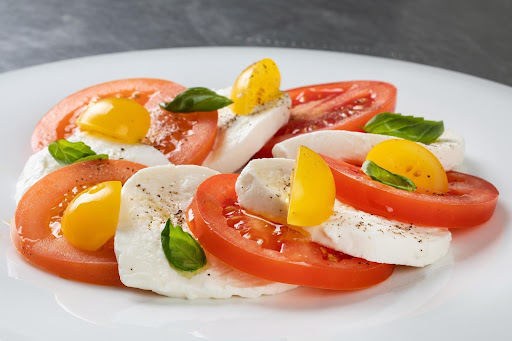
Caprese Salad

Sometimes, however, it is a vague point of view. For this reason, it would be better to investigate the cuisine of the different Italian cities. Italy bases its identity on this very thing: it is an extraordinary network of cities, which took shape since the Middle Ages. However, we can find a few broad categories of description. In the regions of Northern Italy, we find the culture of large, aged cow cheeses, where the local cuisine is designed on the scents of butter, tasty risotto, and stuffed pasta of different shapes and with local unique names. In Central and Southern Italy, on the contrary, butter is an almost unknown ingredient. Here, extra virgin olive oil wins. The table finds its best form of expression in bread and pasta. Much more important in these regions is the use of legumes, vegetables and fish. Sheep’s milk cheeses become protagonists. Finally, pork and cold cuts are an important element of union between North and South. Everywhere in Italy it is possible to find excellent preparations and excellent examples of this products interpreted by the local culture.” 
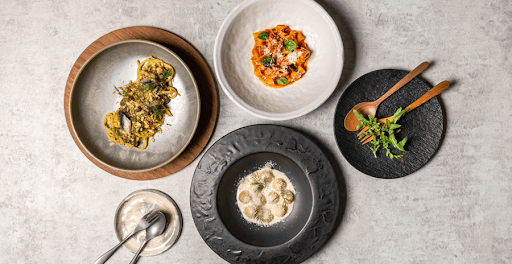
Italian Pasta Dishes 

Ms. Sabbioni echoed, “To put it simply, it can briefly say that even though the country has 20 regions, Italy actually has hundreds of different cuisines that create the chapter of the Italian regional gastronomy.”  

Key representative or authentic Italian dishes

Both instructors agreed that it is not easy to identify dishes that are representative of this wide perspective and history. “This is because any choice we will make will displease someone. In each city in Italy there are people who argue that their own specialty is a national icon.”
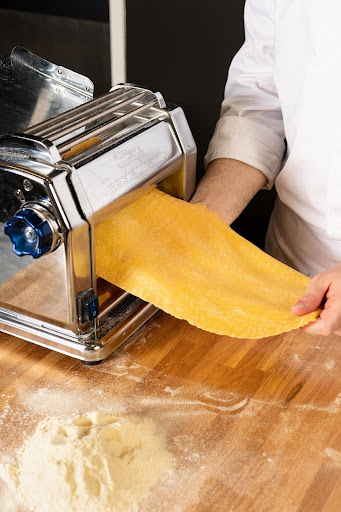
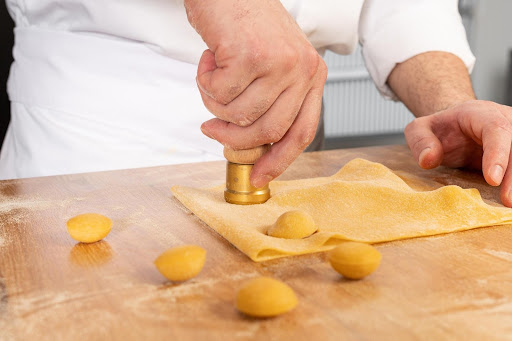
“A symbol that brings everyone together, from North to South, is pasta. The pasta that today represents Italian cuisine in the world. But even this can be considered the title of a long novel. Reason being under the name of pasta we find, once again, great diversity. In terms of shapes, sizes, textures, or cooking techniques. Pasta is cooked in boiling water. In Italy it becomes the main character of a meal and is never considered like as side dish. 

However, it can also be cooked in the oven. From North to South there be many recipes for pasta cooked in a baking pan, layered with different ingredients. Pasta al forno, as we say. This is the case of the famous Lasagna: representative dish from Bologna, in the Emilia Romagna region, in Northern Italy. Bologna is the capital of Emilia Romagna and lasagna is a must over there. It is the iconic preparation for the Sunday lunch, the symbol of the cucina della nonna (grandmother’s cuisine). Today, it is a main course that represents Italy all over the world.”

Given the long history of Italian culinary identity, I asked both instructors to give us their perspective on how they see Italian cuisine has changed over the years. Mr. De Rosa commented, “Traditional recipes are an inexhaustible source of inspiration  for contemporary cooks. Cooking is constantly changing. We cannot stop it in time or history. Traditional recipes can be a perfect springboard for new ideas and new proposals.”
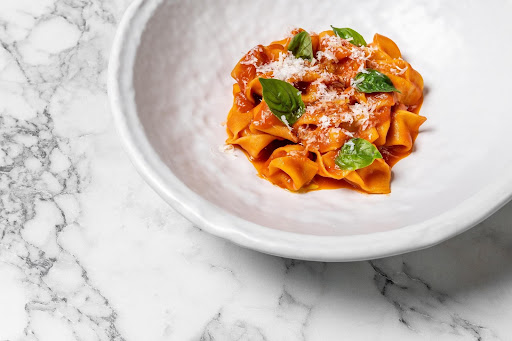
Tortellini bugiardi al pomodoro 

Ms. Sabbioni commented, “The cuisine is a mirror of the society in which we live. It represents trends and changes. For this reason, Italian cuisine is also undergoing profound changes. The time dedicated to cooking  in our homes has also changed. People buy products already cooked by the food industry. It is not always easy to buy foodstuffs directly from local farmers and people must appeal to big retailers. However, in Italy it is still possible to choose where to buy food, which food to consume and how much time to dedicate to the culture of the table. People eat out more often and order takeaway food. 

Today, Italians pay more attention to calories, to wellness and look for the right balance in food. There is an increased interest in organically grown products and a search for local and seasonal ingredients. The consumption of vegetables is higher, and the consumption of meat is decreasing. There is space for ethnic cuisines and new flavours from all over the world. In any case, the table continues to be a fundamental part of life in the Italian society.”
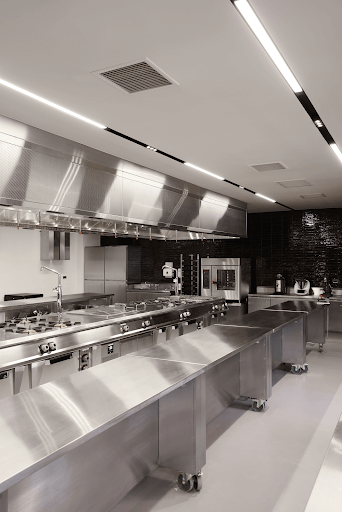
   Western Kitchen at The Food School Bangkok  

As our interview drew to a close, the instructors welcomed our readers to visit their Food School in Bangkok to learn about authentic Italian gastronomy. The Food School is Thailand’s first International multi-brand culinary school, occupying 3,200 sqm of thoughtfully designed space set over three floors at the new Creative & Start-up Village in the city’s Sam Yan district, just a five minute walk from Sam Yan MRT underground station. The school is a significant milestone for Italia culinary arts because it will see, for the first time in Thailand, a new joint venture project of ALMA of Parma. ALMA is the world’s leading educational and training centre for the Italian food, beverage, and hospitality industries.
0 comment
0 FacebookTwitterPinterestEmail

Story by Kathleen Pokrud

Photo by Jenny Chan and Teresa Biesty

Foreword by

H.E. Mr. Bernardo Cordova Tello

Ambassador

The Embassy of the United Mexican States

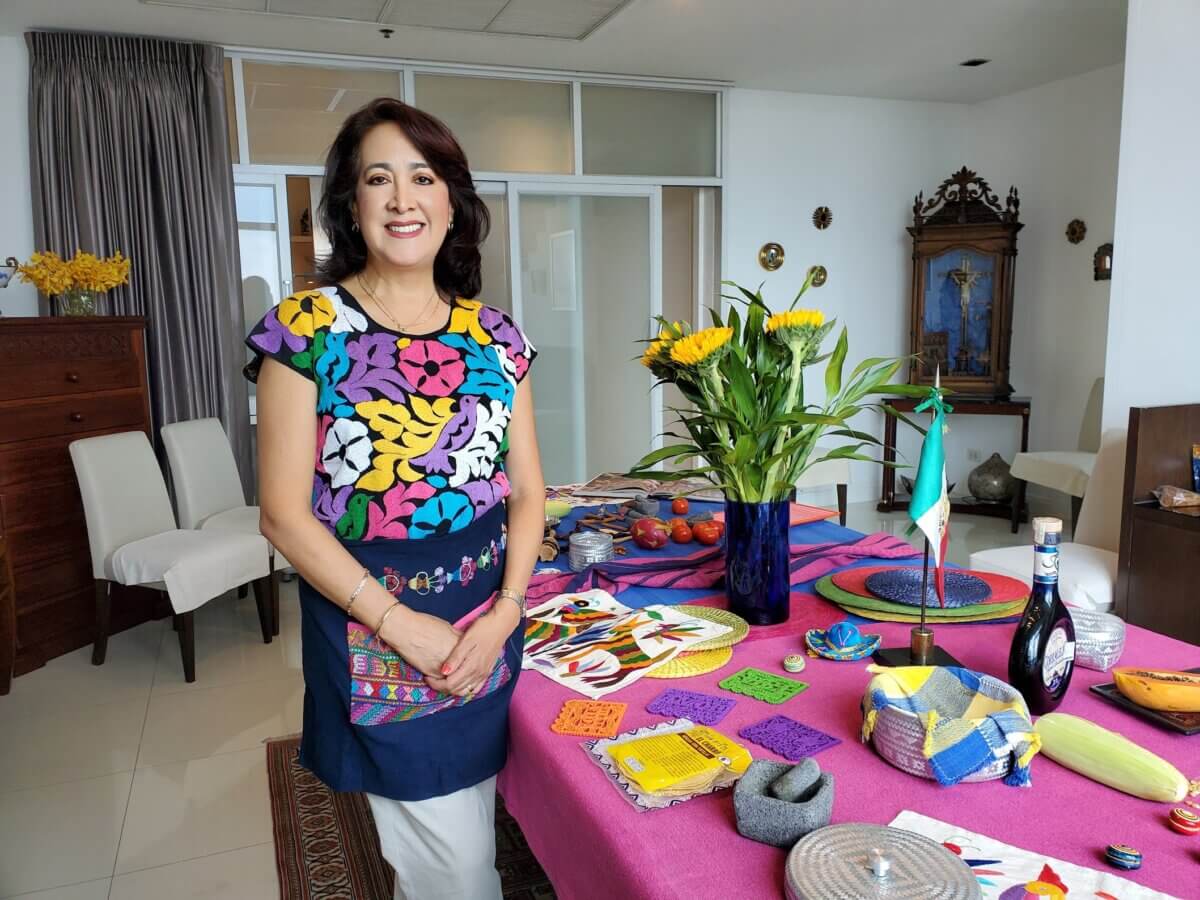
I was delighted when I heard that Kathleen intended to publish an article about Mexican cuisine. To quote the words of Tom Parker Bowles, who, like Anthony Bourdain and other international food critics, have expressed their passion for Mexican food. Tom pointed out years ago that “the most exciting, vibrant, captivating and seductive food that exists on earth” is Mexican food, which “has conquered the world, not only with its dishes, but with the passion, creativity, warmth and the love for life that their creators stamp on the dishes”.

This British food critic stated that he considers Mexico as “one of the most diverse, beautiful and kind countries in the world; for its people, its land, its love.” Regarding some negative news broadcasted by some international media, Parker pointed out that: “Mexico is a pure, generous and hospitable land; anyone who loves this country is able to see beyond the problems”

Story by Kathleen Pokrud

Do you know that Mexican food is officially considered a cultural heritage of humanity? In 2010, UNESCO (the United Nations Educational, Scientific and Cultural Organisation) inscribed Mexican cuisine on their Representative List of the Intangible Cultural Heritage of Humanity. I sat down with Madame Adriana Mendez Murguia from The Embassy of the United Mexican States to learn how Mexican gastronomy was enriched over the years.

To summarise Mexican gastronomy in two lines, many would agree that it was born in the entrails of the country over thousands of years and has become into something that is widely appreciated all over the world, and there are many proofs of that. From Diana Kennedy’s books to Anthony Bourdain’s letters and shows, to Netflix series featuring Mexican food. Experts estimate that about 15% of the food ingredients that are used in the world are originally from Mexico. Which is quite impressive! 

Madame Adriana described the history of Mexico cuisine, “Our traditional cuisine is a comprehensive cultural model comprising farming, ritual practices, age old skills, culinary techniques and ancestral community customs and manners. It is made possible by collective participation in the entire traditional food chain: from planting and harvesting to cooking and eating. The basis of the system is based on corn, beans and chilli; unique farming methods such as “milpas” (rotating swidden fields of corn and other crops) and “chinampas” (manmade farming islets in lake areas); cooking process such as nixtamalization (lime hulling maize, which increases its nutritional value); and singular utensils including grinding stones and stone mortars. Native ingredients include varieties of tomatoes, pumpkins, avocados, cocoa and vanilla provides variety to the basic staples.”

She further explained, “Aside from the ingredients previously mentioned, there is wider variety of that ingredients are originally from Mexico; such as turkey, papaya; pitaya (widely known outside of Mexico as dragonfruit), chia seeds, a wide variety of chilli’s, agave from which tequila and mezcal are made, nopal (cactus) and its fruit called tuna, beans and corn, amaranth, green beans, jicama and squash.”

Madame Adriana proudly remarked, “To this natural wealth, it is important to include the different influences Mexican gastronomy received over time, especially from Europe and the Middle East. First, from Spain for 300 years, and in the 19th century there was a strong French and Austrian culinary influence from the empire of Maximilian of Habsburg. Thanks to this influences and fusion, Mexican gastronomy was enriched even more. It was a slow and progressive process that culminated by the end of the 20th century when UNESCO recognised Mexico’s cuisine as intangible cultural heritage of humanity. UNESCO first registered our Mexican cuisine in 2010, even before the French cuisine, which was added to the list in 2012, followed by the Mediterranean and Japanese, both in 2013. According to world popular rankings, Mexican cuisine is among the top five most popular and prestigious cuisines in the world, along with the French, Chinese, Japanese and Indian ones.”

Mexican food and its culture are unique according to Madame Adriana, “Although many of our dishes are based on the traditions of ancient cultures and peoples (Aztecs, Mayans, Tarascans, etc.), they also have contributions from Mediterranean and European cultures, incorporated during the colonial era. These processes have been further enriched by influences from the Middle East and Asia over the years. Precisely, these mixed influences make Mexican gastronomy a clear reflection of the country’s culture. Thus, Mexican food, aside from being delicious, unique, colourful and highly valued internationally, is the product of the history and culture of Mexico.”

To underline an important fact, “Our gastronomy is product of a millenary culture and of the historical continuity and additions to ancient traditions. It also plays an important role as an element of identity for the Mexican people. Mexican food is collectively produced, is based on products originating from a very diverse land and boasts great creativity in its chefs, who over the centuries have been perfecting our gastronomy. It is a very balanced and healthy diet that for millennia has nourished the Mexican people.”

With the long traditional culinary history of Mexican story, I asked Madame Adriana on how Mexican food is influenced by. She replied, “From my personal point of view, there are two main elements to consider to evaluate a national gastronomy. The first set of elements is given by nature. Mexico is one of the most mega-diverse countries in the world, with more than 10,000 kilometres of coastline, tropical regions, arid zones, deserts, mountains, some of them with snow, large forests and valleys. On the other hand, Mexico is the cradle of great ancient civilisations: Olmecs, Teotihuacans, Purepechas or Tarascans, Zapotecs, Mayans and Aztecs, amongst many others.”

She elaborated further, “These two characteristics allow Mexico to have a great cultural and culinary diversity, but with common central elements in its gastronomy such as the central use of corn, tomato, chocolate, turkey, avocado and a wide variety of vegetables, seeds, fruits, fish and shellfish. Even some native flowers are used in the preparation of certain dishes.”

“Added to this natural and historical wealth, there is the influence that came from Europe and the Mediterranean throughout the centuries, including even influences from Asia thanks to the contributions received by the Acapulco Galleon, which operated for more than 200 years between the centuries XVI and XIX. Thanks to the sea route from Asia, spices, several kinds of fruits and rice arrived, which are now part of the daily diet of Mexicans. Likewise, Mexican contributions such as papaya, pitaya, chillies, tomato, avocado, chocolate and flowers such as cempasuchil (marigold) and poinsettia arrived to Asia.”

Key representative dishes

The list is a very long one, given the diversity and complexity of Mexican food. On the Mexican coasts, fish, shellfish and a great variety of “ceviches” (raw fish) stand out. The ceviche is also typical of various Latin American countries with coast to the Pacific.

In the central part of Mexico, “mole” is very common. Mole is a very complex sauce, which can include 20 or 30 ingredients, and it can take days or weeks to prepare. It is the dish that is used for great celebrations or special occasions.

In the North, the popular dishes are “cabrito” (baby goat) and different kinds of “barbacoas” (lamb meat wrapped in agave leaves and cooked underground on low heat overnight), which is a very typical dish to have on Saturdays or Sundays.

The country has an extensive variety of soups, salads and stews, even their fast food is also well known in the world, mainly meat tacos, which can be filled with beef, pork, lamb, chicken or even fish.

There are extensive selection of dairy based dishes, with a wide variety of cheeses, milk and sour cream. No doubt the dairy products guarantee tasty desserts, and with heavy influences from Spain, France and Austria, are also delicious and diverse.

In addition, there are excellent fruit liqueurs produced in Mexico. Mexico produces quality red and white wines, aside to the world famous tequila, mezcal, as well as beer.

Gastronomy, like any other cultural activity, is not something static; it evolves over time and through contact with other influences from other regions of the world. This tradition is the heritage of past civilisations, a culture inherited and transmitted from generation to generation that gives its own identity to each region of the country, making up the cultural mosaic that is Mexico.

Madame Adriana admitted, “Mexican cuisine is ancient and diverse due to its great wealth and geographic diversity. This tradition merges and is further enriched with the arrival of the Spaniards to Mexico. New products and spices are incorporated, and form a wide variety on which the “Criolla” (Creole) cuisine was established, that is, the fusion of both cultures. By the late 19th century, the elaboration of a more sophisticated food promoted by the government and the elites took hold. Good cooks were hired and even Italian and French chefs were hired in Mexico to teach new dishes and cooking techniques, which were incorporated into the Mexican cuisine. The growth of large cities in Mexico throughout the 20th century, and the arrival of international tourism generated the opening of hotels and large restaurants. This generated interest and taste for good Mexican cuisine, which has become one of the main tourist attractions in the country, because international tourists have been able to discover the richness and diversity of Mexican cuisine, which is delicious and unique.”

0 comment
0 FacebookTwitterPinterestEmail

Le Méridien Bangkok is welcoming the world back to Thailand’s vibrant capital city following an extensive refurbishment that has elevated every aspect of this stylish, art inspired hotel.

Nestled in the beating heart of Bangkok, surrounded by the restaurants, bars and nightlife of the Silom district and connected by Sala Daeng BTS and Sam Yan MRT stations, Le Méridien Bangkok puts guests in the heart of the action. With Bangkok now welcoming international visitors without any travel restrictions, guests can discover a new era of revitalised guest rooms and dining concepts that take inspiration from Bangkok’s treasure trove of traditions, artistic culture and upbeat urban vibe.

Definitive first impressions are created by the new look lobby where the iconic I-Jud giant white dog statue awaits with a playful welcome.

Marriott International Hotel

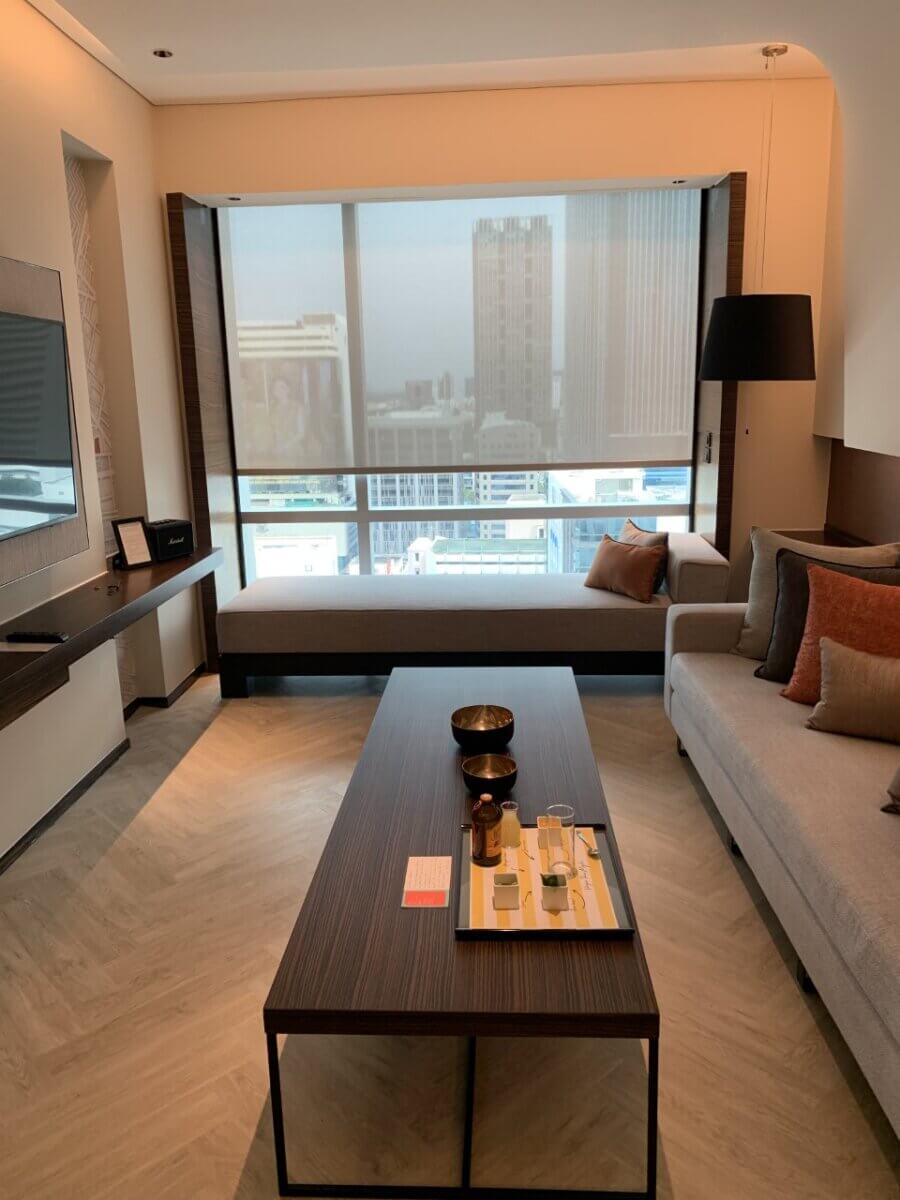
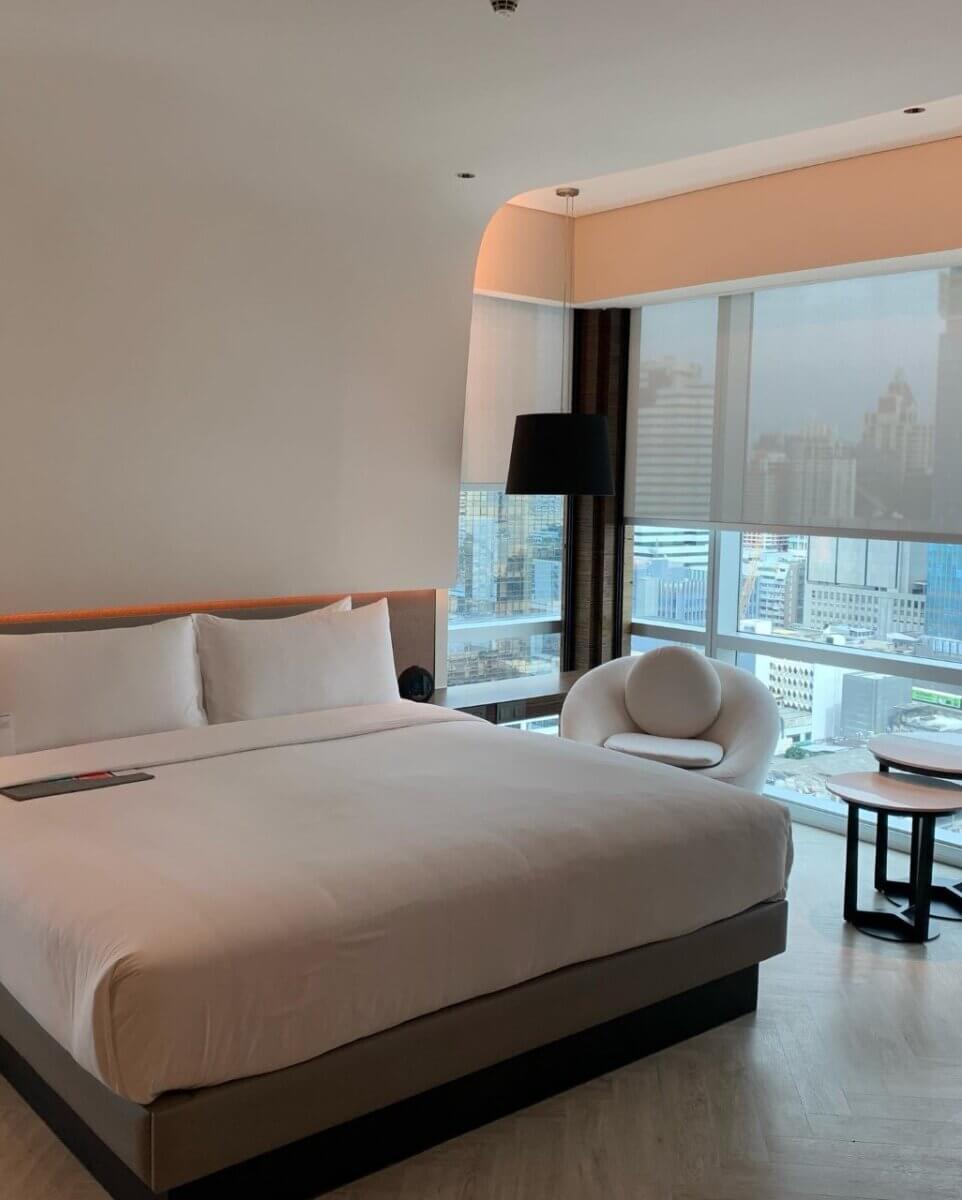
The refreshed and fabulous guest rooms are built with ergonomic design and modern amenities, such as touchscreen IP phones, LED Smart TVs and Bluetooth speakers. The rooms are complemented with comfy sofas, big floor-to-ceiling windows, extra long working desks with a number of electrical outlets for all business travellers, deep soaking tubs and separate rain showers to create a deep sense of calm. With striking views of the city from street to sky, these refreshed rooms set the stage for immersive urban adventures.

Marriott International Hotel

At Latitude 13 Indoor, à la carte local and international snacks and shareable dishes are available throughout the day. Signature items range from bomboloni sweet sensations to savoury crostini. Outside visitors are welcomed to take advantage of the friendly outlet in the lobby as a casual meeting places throughout the work.

Marriott International Hotel

Surrender to savoury succulence at Rolling Ribs Brew Bar & BBQ, where taste buds are treated to combos of ribs, pulled pork, beef brisket, chicken and more, accompanied by a selection of side dishes such as tangy coleslaw and barbecued corn on the cob, and washed down with signature cocktails straight from the wild west. A must try place for lovers of American style BBQ which gives the feeling of “TGIF feeling”!

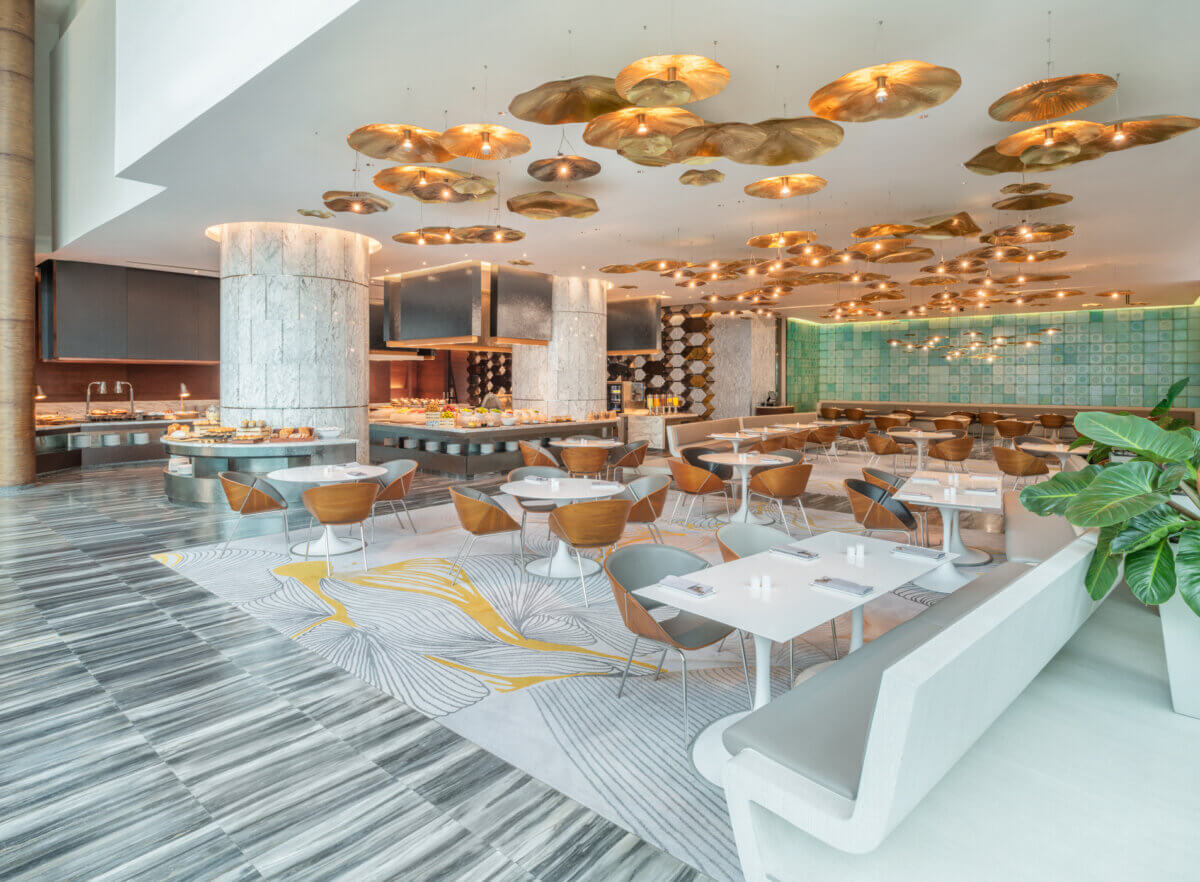
A brand new bar, Tempo, sees mixologists embrace a Japanese attitude and use local plants and herbs to craft high end cocktails. Latest Recipe, the international culinary marketplace, enhances every dining experience with two tempting promotions. “La Cantine” is the restaurant’s brasserie style alter ego, where diners can come and unwind during the day with mouthwatering Euro-centric menus, from giant spinach ravioli and lobster tortelli to Merlot seafood soup, braised beef shin, roasted sea bass and more. Pick from quick two, three or four course set lunches every day from 12:00 to 14:30, priced at 390B, 490B and 590B net respectively. À la carte options are also available. Then in the evening, “Creative Hour” offers 120 minutes of free flow drinks and luxurious light bites between 19:00 and 22:00 hrs, priced at just 950B net per person!

Inspired by the rich traditions of European spas, SPA by Le Méridien breaks away with refreshing interpretations reflecting the sophisticated ways of today’s international travellers. Seven treatment rooms are configured in circles to represent the global meridian from which the brand derives its life force. All treatments and therapies seek to achieve purification, restoration of natural energy, and mind and body harmony.

To celebrate the return of refined European hospitality to Le Méridien Bangkok, guests and local residents are invited to explore “Au Soleil by Le Méridien”. Allure yourself with afternoon tea, spa treatment and many more initiatives under Au Soleil theme at Le Méridien Bangkok

For more information and reservations, please contact 02 232 8888 or [email protected]
Website: www.lemeridienbangkoksurawong.com
Facebook: www.facebook.com/LeMeridienBangkok
Line: @lemeridienbangkok

0 comment
0 FacebookTwitterPinterestEmail

The unique Turkish cuisine, a defining element of the country’s cultural identity, was introduced at the newly launched Turkish Cuisine Week. Held for the first time this year from 21 to 27 May, Turkish Cuisine Week aimed to showcase Turkish dishes with all their original qualities as the crown of our tables. The event will be celebrated with promotional events in Turkey and abroad.

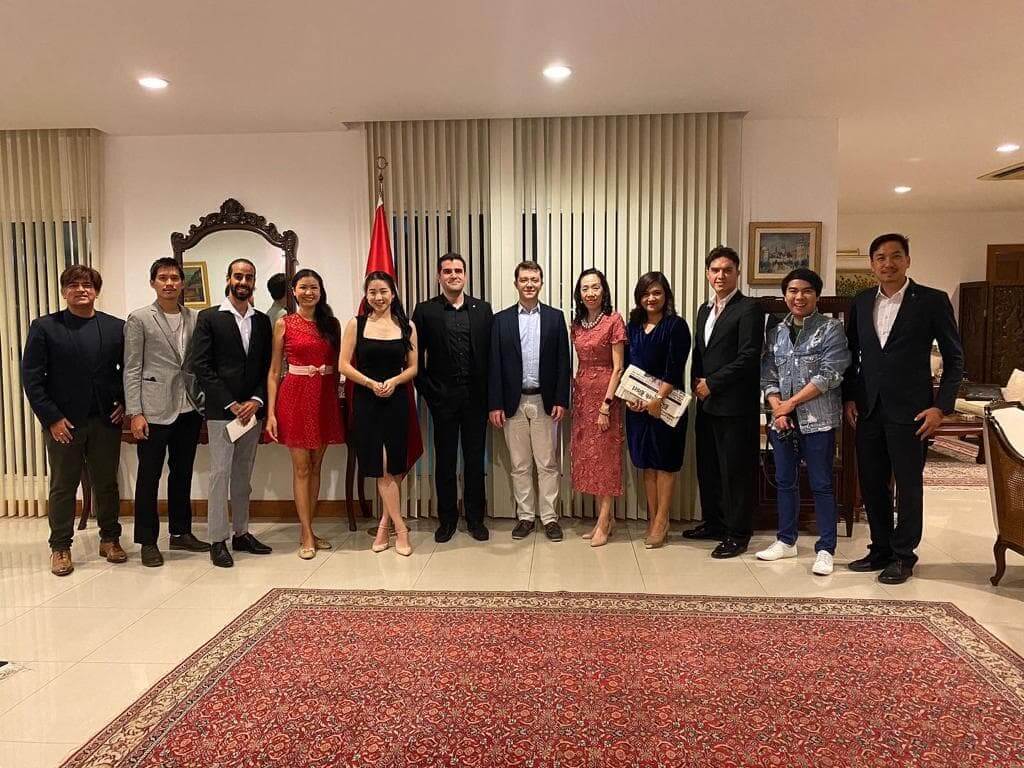
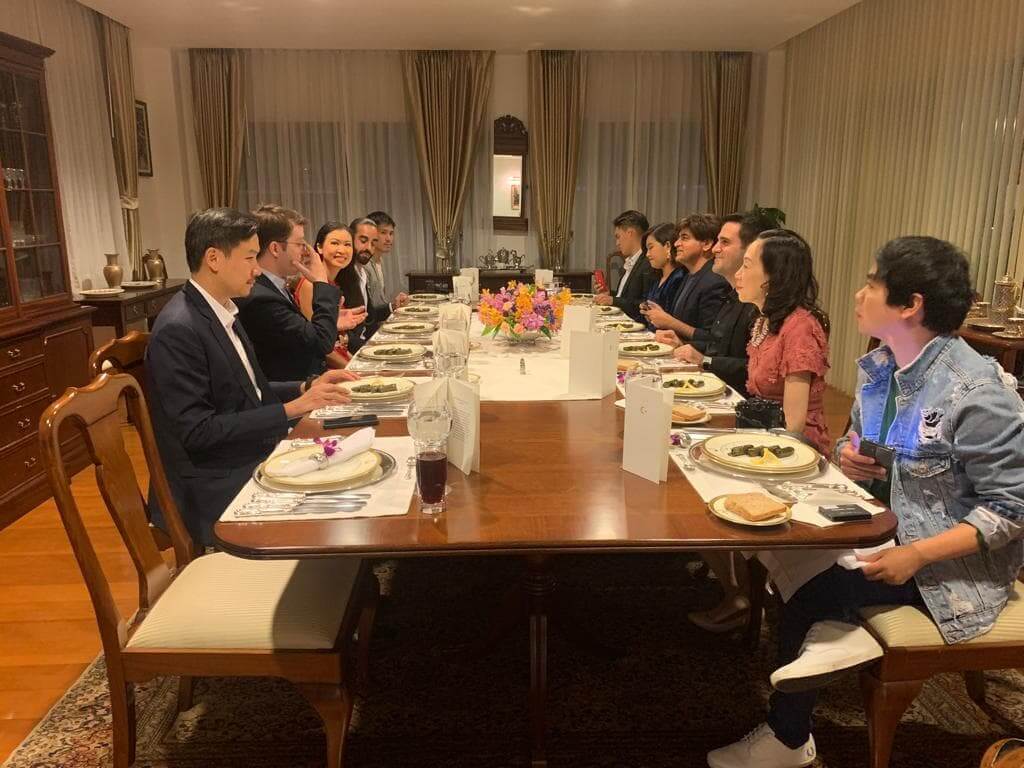
In Bangkok, a sumptuous feast was arranged at the residence of H.E. Ms. Serap Ersoy, Turkish Ambassador to Thailand. The dinner was hosted by Mr. Melihcan Ersen, Second Secretary to a selective group of guests to sample the timeless recipes. According to Mr. Ersen, “From this year onwards, we take a humble step forward with Turkish Cuisine Week towards highlighting and emphasising the healthy, zero waste and traditional character of Turkish cuisine. We invite the public to take time and experience Turkish cuisine, not only for trying new and extraordinarily delicious recipes, but also a means to embrace a sustainable, wasteless, balanced and a healthy lifestyle.”

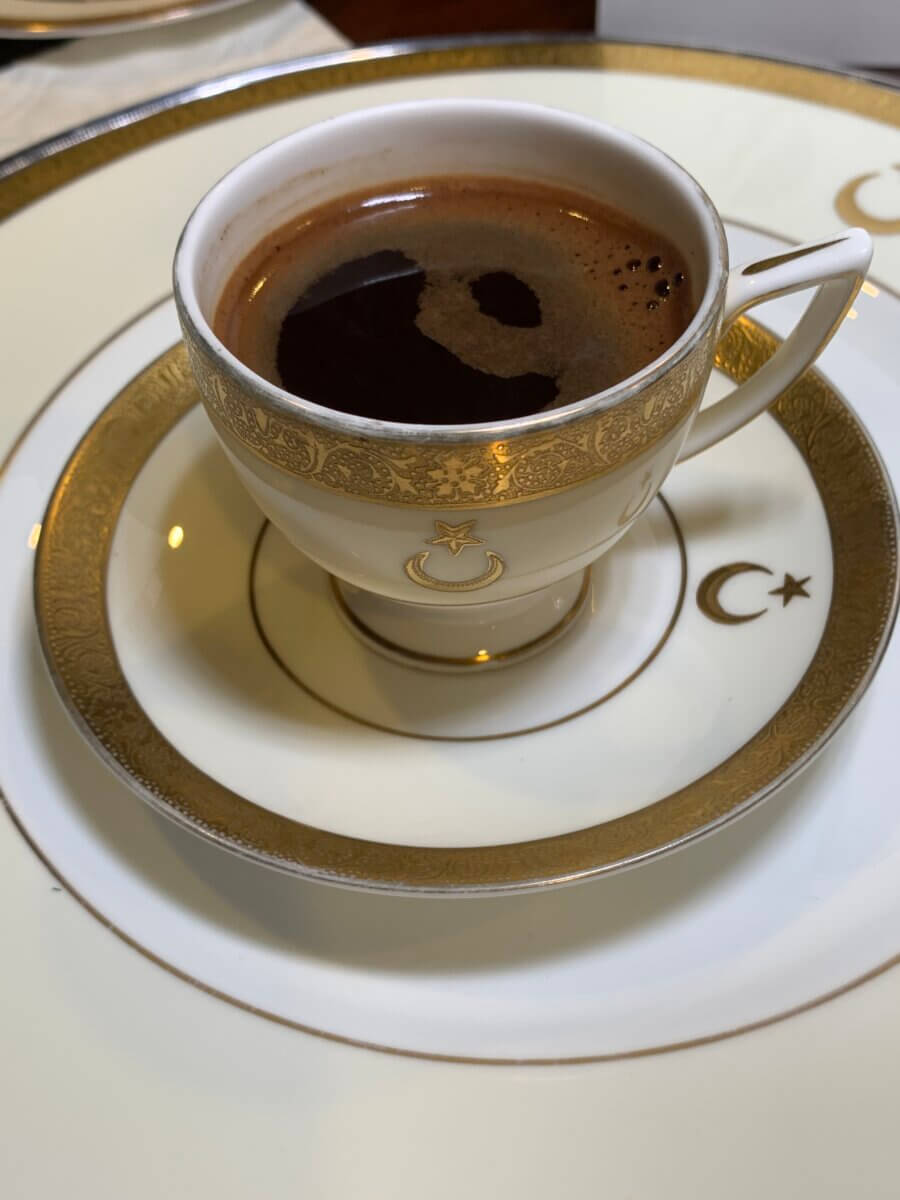
Turkish cuisine

Turkish cuisine, nurtured and shaped by the deep rooted Anatolian history, stands out with its healthy characteristics, creative aspect, and sustainable structures. Mr. Ersen explained, “The flavours of Turkish dishes, influenced by thousands of years of history and the Seljuk and Ottoman palaces, carry a vast cultural accumulation to the present day. Dishes and meals that utilise every element of a product, without waste, reveal an ecologically sustainable tradition of taste. Offering countless options for vegetarian and vegan diets along with restorative pickles and vinegars, Turkish cuisine is also a world cuisine with the potential to respond to all dining trends.”

Turkish cuisine presents to the world its legendary flavours, each of which reflects centuries old knowledge and cultural heritage. During Turkish Cuisine Week, meals prepared with creative presentations by Turkey’s world famous cooks were offered to visitors in their own geography, with hospitality held in different countries. At the same time, menus created specifically for Turkish Cuisine Week in Turkey invited both Turkish and foreign guests to experience the best examples of Turkish cuisine in restaurants.
Turkish Cuisine With Timeless Recipes 

Turkish Cuisine With Timeless Recipes (Asırlık Tariflerle Türk Mutfağı) is the gastronomy book published under the leadership of First Lady Emine Erdoğan and under the auspices of the Presidency, in cooperation with the Turkey Tourism Promotion and Development Agency (TGA) with the support of the Ministry of Culture and Tourism, Aimed at promoting the richness of Turkish cuisine to a global audience and featuring contributions from prominent chefs, academics and experts, Turkish Cuisine With Timeless Recipes draws attention to the famous Turkish cuisine and its waste free, ecological and sustainable characteristics.

In addition to discussing the healthy storage and cooking techniques used in Turkish gastronomy, the book is intended to record centuries old traditional recipes in their original form, and make them accessible to future generations.

Published in Turkish and English, the book presents 218 recipes for healthy and alternative diets, including recipes for waste free, fermented, regional, local and gluten free dishes. The dishes and beverages in this book represent examples of the rich Turkish culinary culture.

Samples of Istanbul themed menu

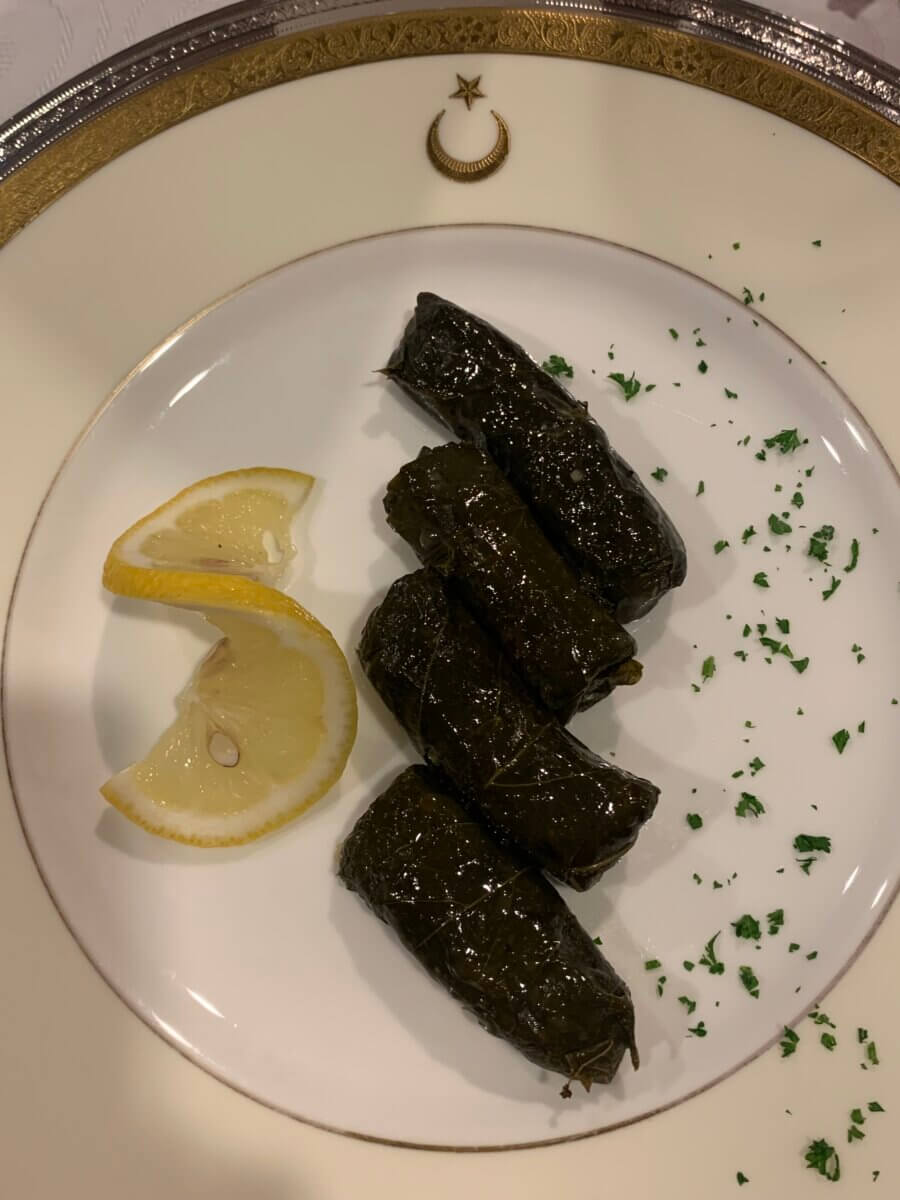
Yaprak Sarma (Stuffed vine leaves)

Vine leaves are the most widely used type of leaves in Turkish cuisine for both meat and olive oil sarmas. Developed from a recipe from the Ottoman period, stuffed vine leaves combines sweet and sour flavours with the aromas of cinnamon, plenty of pine nuts and currants. Today, lemon slices have replaced the sourness of sour cherries, which were more commonly used during Ottoman period. Stuffed grape leaves in olive oil are cooked using different spices in every region and every home, sometimes sweet and sometimes slightly bitter, but always with a sour touch.

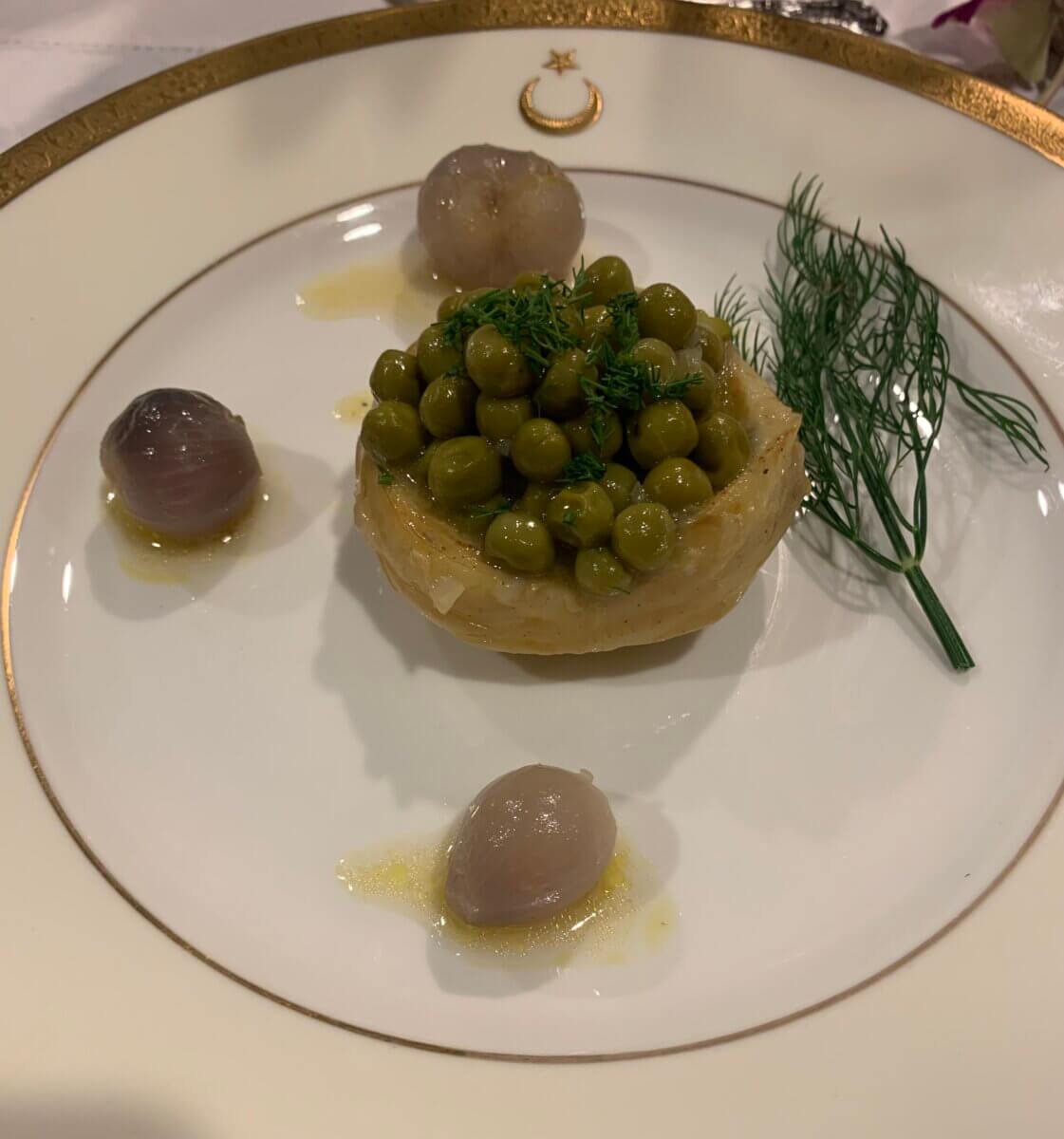
Zeytinyağlı Enginar (Artichokes braised in olive oil)

ilaki or braised fish stews are not only prepared with fish but also with shellfish such as mussels and clams, or legumes. The main ingredients of pilaki are onions, garlic, vinegar or lemon juice, parsley and olive oil. Various vegetables such as; potatoes, carrots and celeriac enhance the flavors further. All the ingredients are simmered gently on the stove over a low heat with a small amount of water, or it can be cooked in the oven as in this recipe.

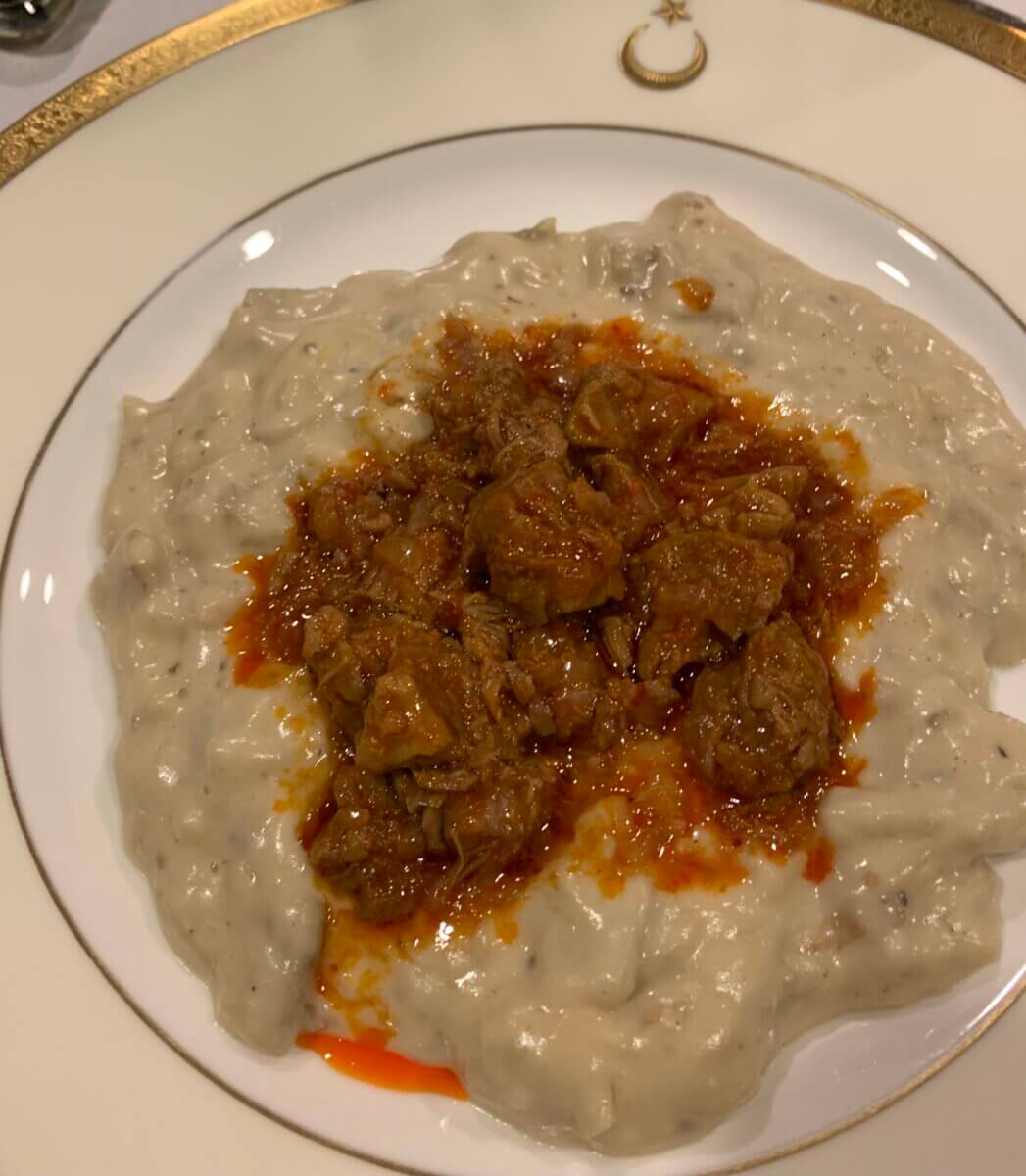
Hünkâr Beğendi (Lamb stew with velvety eggplant puree)

As the name suggests, Hünkârbeğendi (Sultan’s Delight) is a dish worthy of Sultans. This is a popular dish served to entertain guests in the best possible way. In Turkish cuisine, it is a popular practice to roast eggplants and purée the flesh. However, preparing a roux similar to the technique used for béchamel sauce, and flavouring it with plenty of cheese indicates traces of Westernisation.

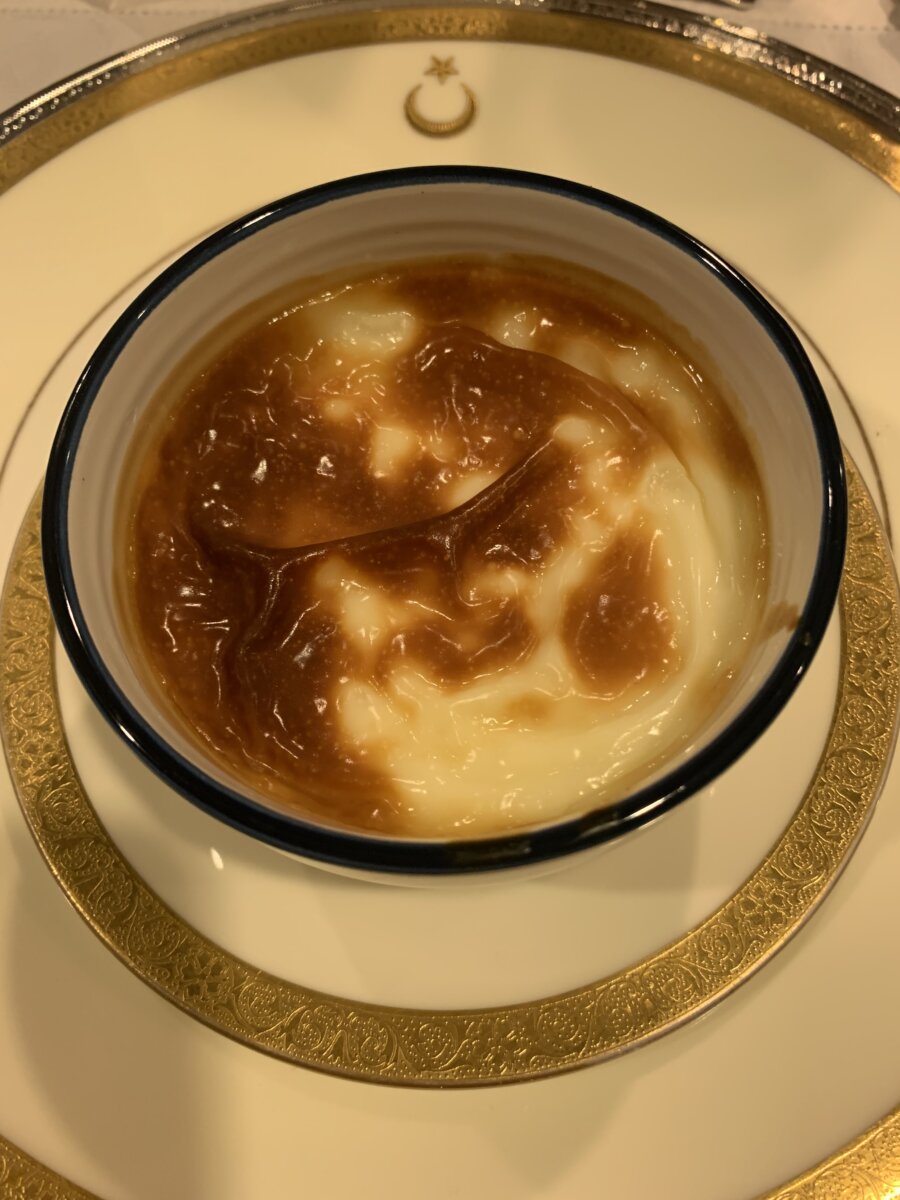
Sütlaç (Oven baked rice pudding)

Fırın Sütlaç (oven baked rice pudding) was one of the most popular of the Ottoman cuisine. It also gained fame in Europe as Turkish style rice pudding. Today, rice pudding is one of the most popular milk based desserts. When the rice pudding is to ready to be baked, egg yolk is added so a thin creamy skin is formed on top, and it is baked until golden brown in the oven.

Expat Life in Thailand readers who want more information on Turkish cuisine, can visit

https://turkishcuisineweek.com/turkish-cuisine-week

0 comment
0 FacebookTwitterPinterestEmail
Independent since 1830, Belgium is a relatively young country, and its history is closely linked to the ones of its neighbours. Being located in the centre of Europe, Belgium is strongly connected to its bordering countries. Throughout its history, it has been part notably, of the French, Austrian and Spanish Empires. Its cuisine is therefore influenced by the cuisine of its neighbours but also by the more recent labour migration, first Italian and then, 50 years ago, Turkish and Moroccan. 
Belgian cuisine is therefore a very diverse cuisine that is open to novelties and influences. The Belgians like to celebrate and that is also clearly reflected in their dishes. I sat down with H. E. Mrs. Sibille de Cartier d’Yves, Ambassador of The Embassy of the Kingdom of Belgium to the Kingdom of Thailand to learn about Belgian culinary story.

I asked Ambassador Sibille about the history of Belgian cuisine, she described, and “Belgian cuisine has been strongly linked to the French for a long time. However, some specifically Belgian dishes date back to the 19th century, like waffles or waterzooi (a soup made of vegetables, cream, and fish). We also find centuries old Mediterranean influence in Belgian cuisine, as Italian merchants were regular visitors to the city of Bruges, which was a commercial metropolis at the centre of Europe in medieval times.”

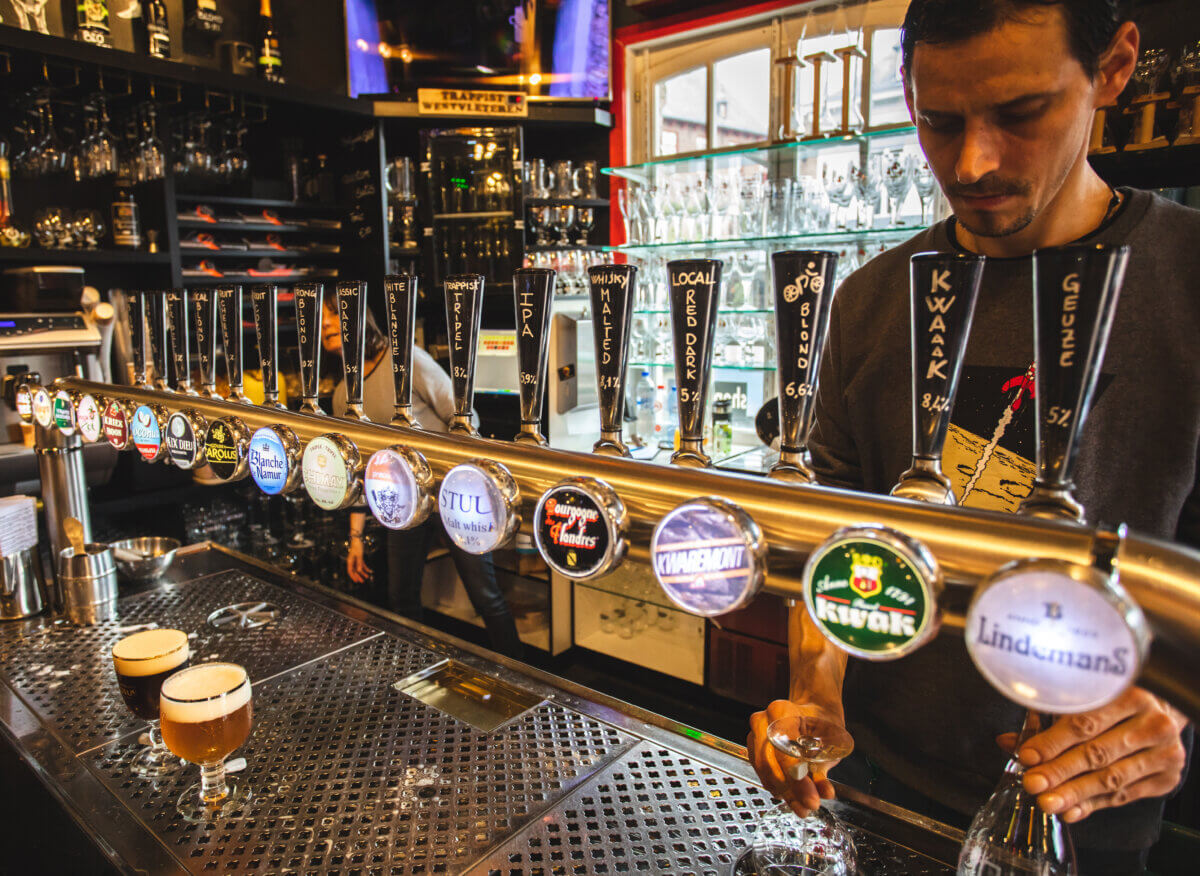
Ambassador Sibille further elaborated, “Belgium produces a lot of craft beers and they form the basis of many of our dishes. The North Sea being part of our territory, seafood is traditionally also part of Belgian cuisine, notably in the North of the country. The famous mussels, the Belgian grey shrimps, eels or sole’s are prepared in many different ways. The South of the country has lots of forests, so you will find game meat, such as wild boar and deer, on the menu in wintertime.”

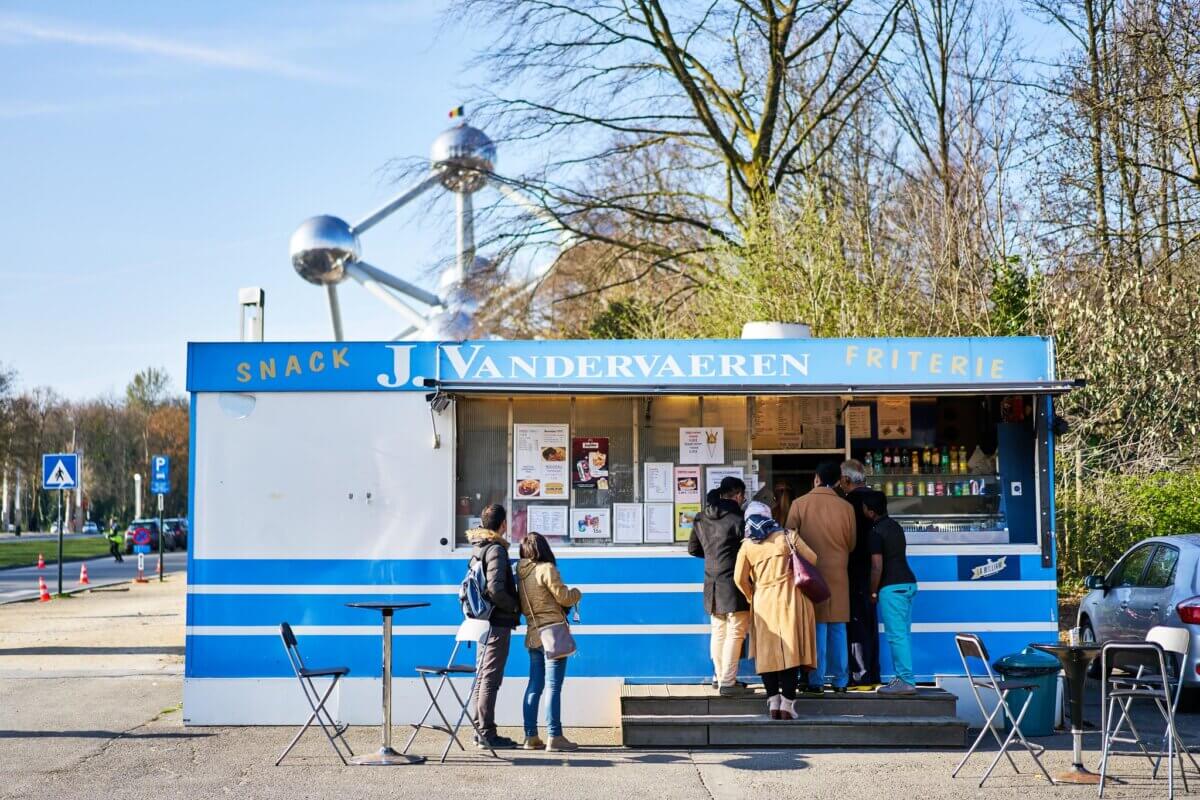
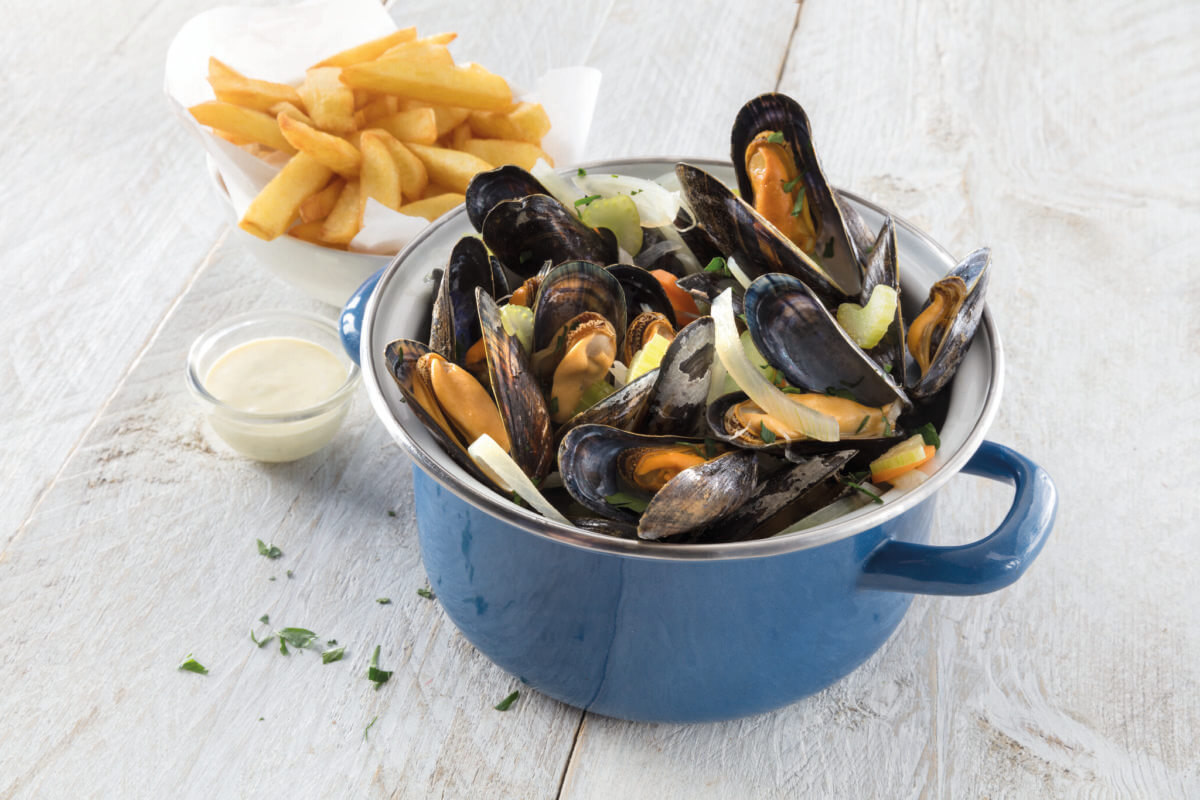
“Brought to Europe from Latin America in the 16th century, the potato has been part of Belgian cuisine since the 18th century. Today, it is an essential part of our food tradition, from street food – with the famous “frietkot” selling fries – to high-end culinary traditions. You will rarely find a Belgian dish without the potato, but its shapes and tastes come in hundreds of variations. Therefore it is not surprising that mussel’s fries became one of our most famous national dishes! As far as vegetables are concerned, endives, white asparagus or the famous Brussels sprouts are typical Belgian accompaniments.”

©visitflanders.com

Belgium_copyright @visitflanders

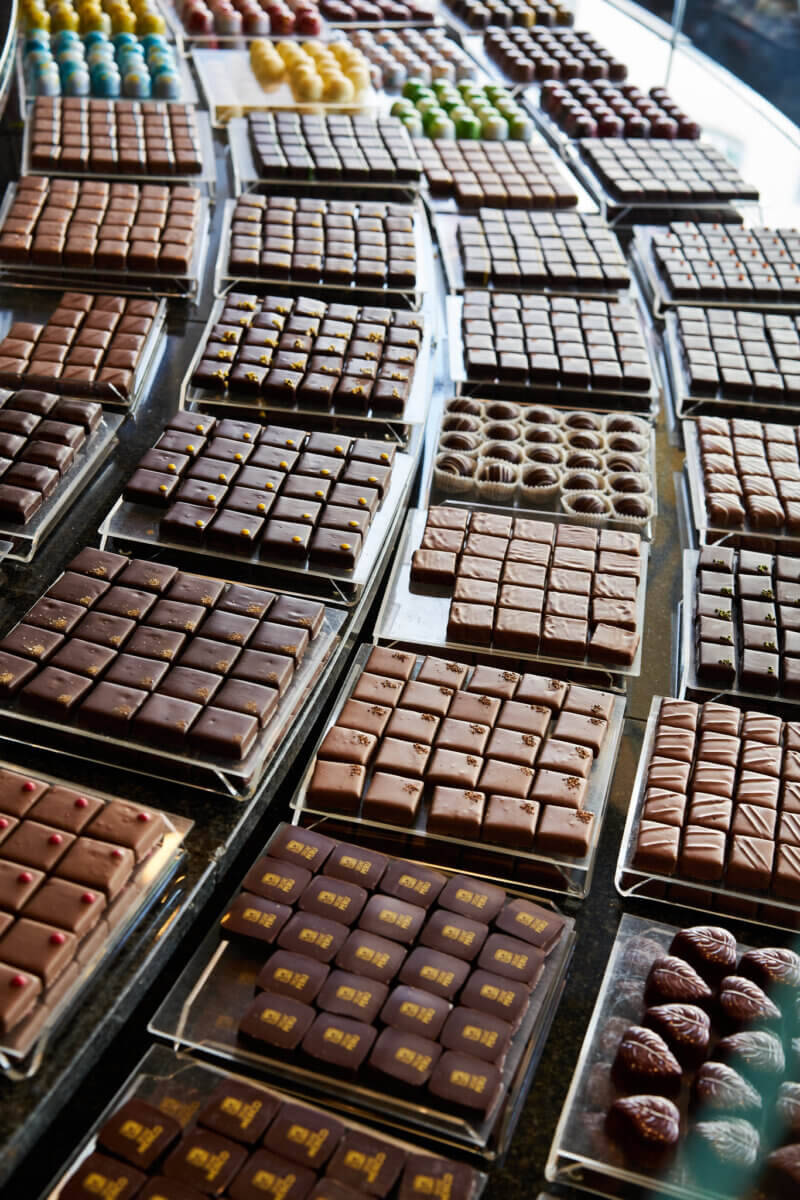
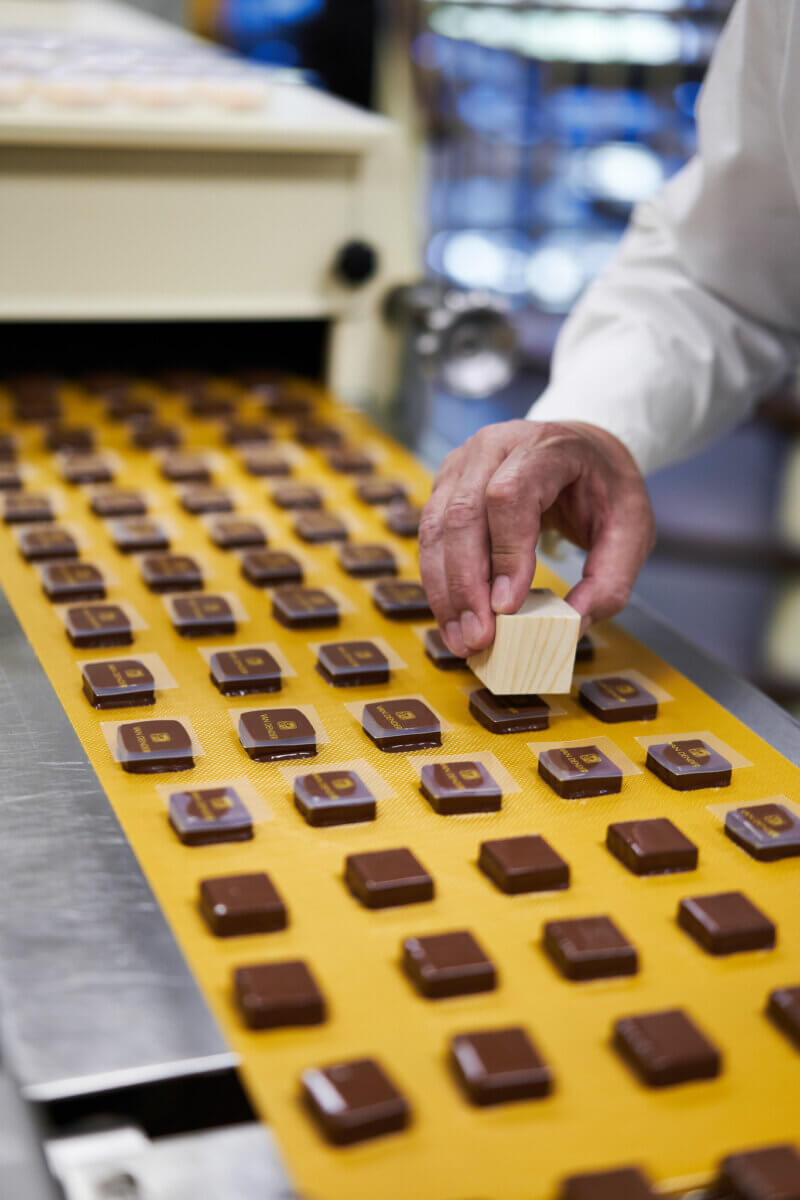
Next, we discussed the popularity of Belgian cuisine in the world, and “Belgian cuisine is mostly known for our flagship products With hundreds of different types being brewed, beer is of course one of our prime export products. The quality of Belgian chocolate, another famous export product, is renowned throughout the world. Waffles are usually also known as one of Belgium’s culinary specialties, just as mussels and fries – typically eaten in Belgium with a homemade mayonnaise.”

©visitflanders.com ©SPFAE

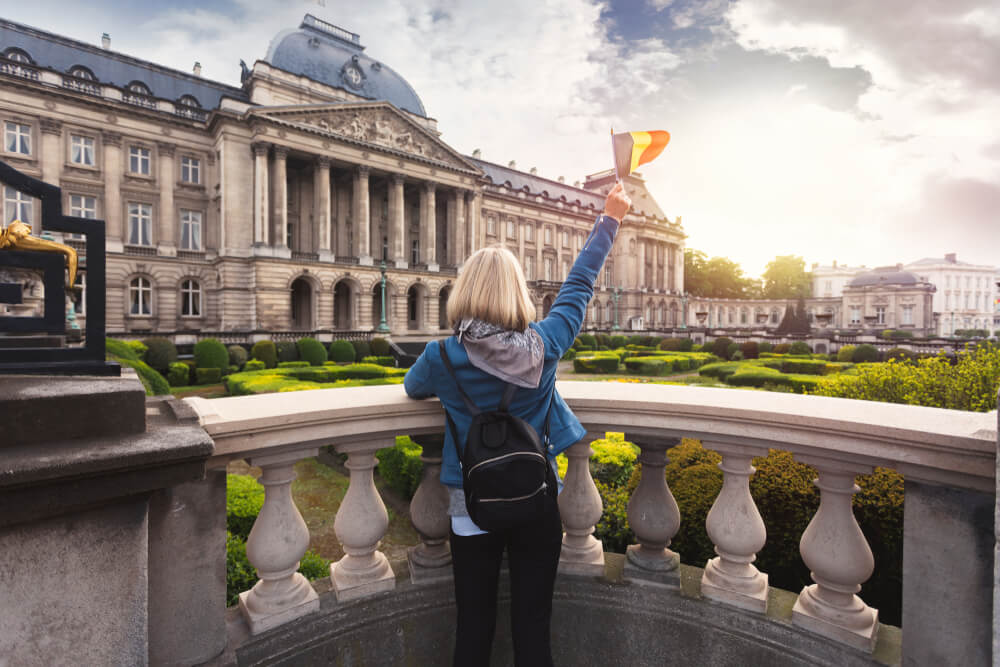
Royal Palace ©SPFAE

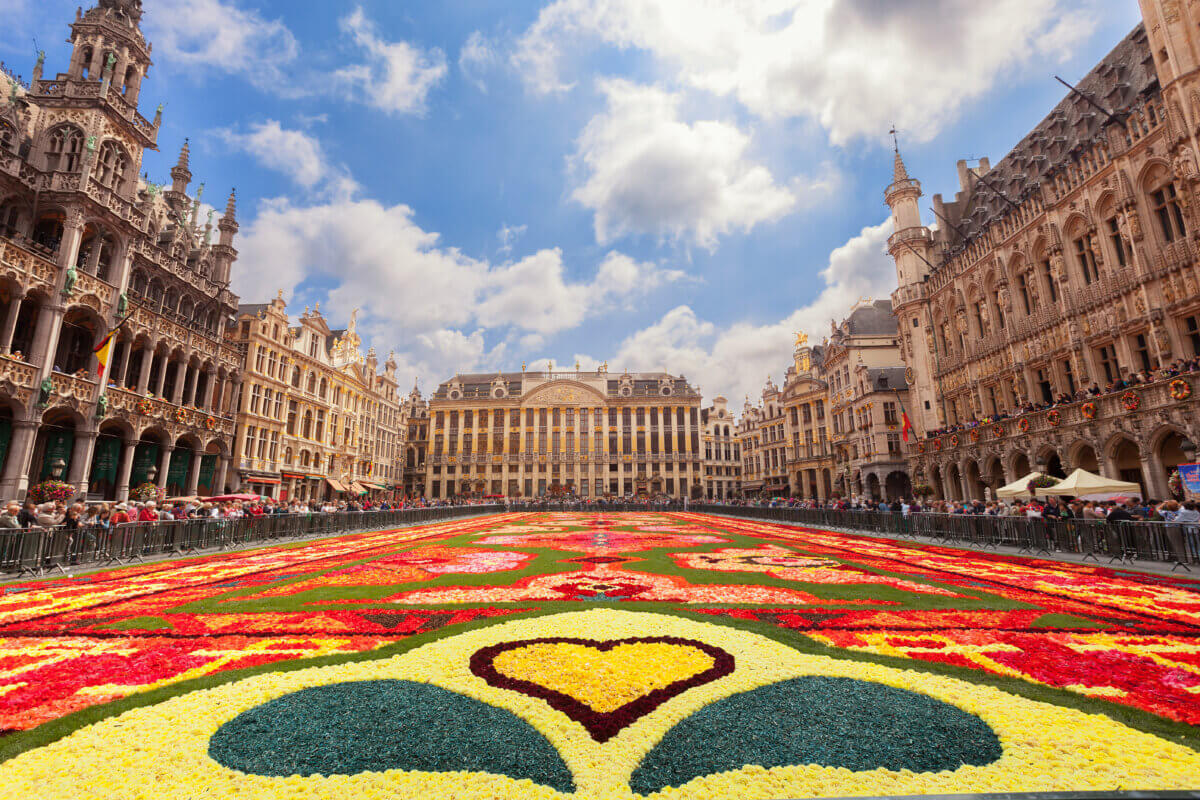
Proudly shared, “Being the headquarters of the European Union, NATO and more than 60 European and international institutions, Brussels has evolved into a truly international city. Did you know that it is the city with the highest number of diplomats in the world? Of course, this international network is also reflected in the presence of restaurants from all around the world in the country, but also in the evolution of Belgian cuisine, which does not shy away from integrating new influences, ingredients and spices. Today, the offer is also being expanded with vegetarian and or vegan experiences.” 

With regard to food culture in Belgium, “What makes Belgian food unique?” Ambassador Sibille candidly answered, “The openness of our citizens to novelties, creativity and “joie de vivre” is probably the main characteristic of our cuisine. The typical Belgian cuisine is a combination of innovation and tradition, with rustic local products adapted to today’s taste and with regular new influences.”

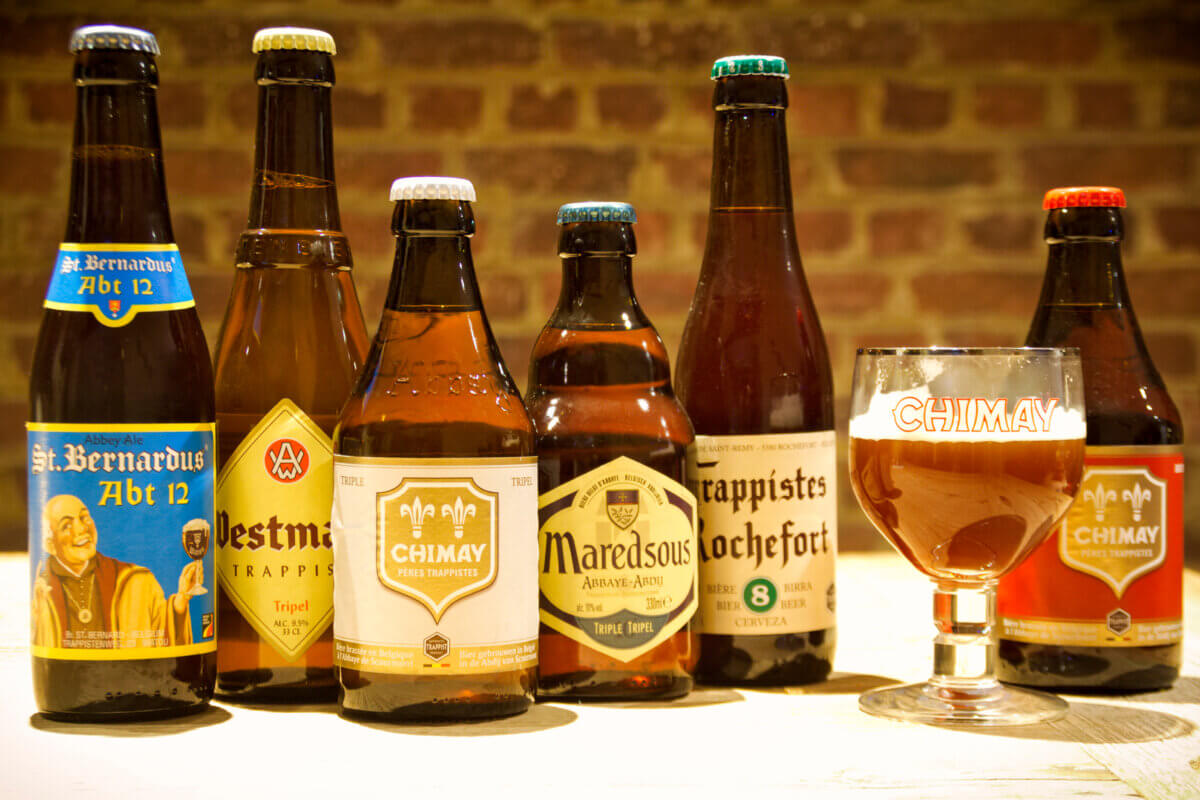
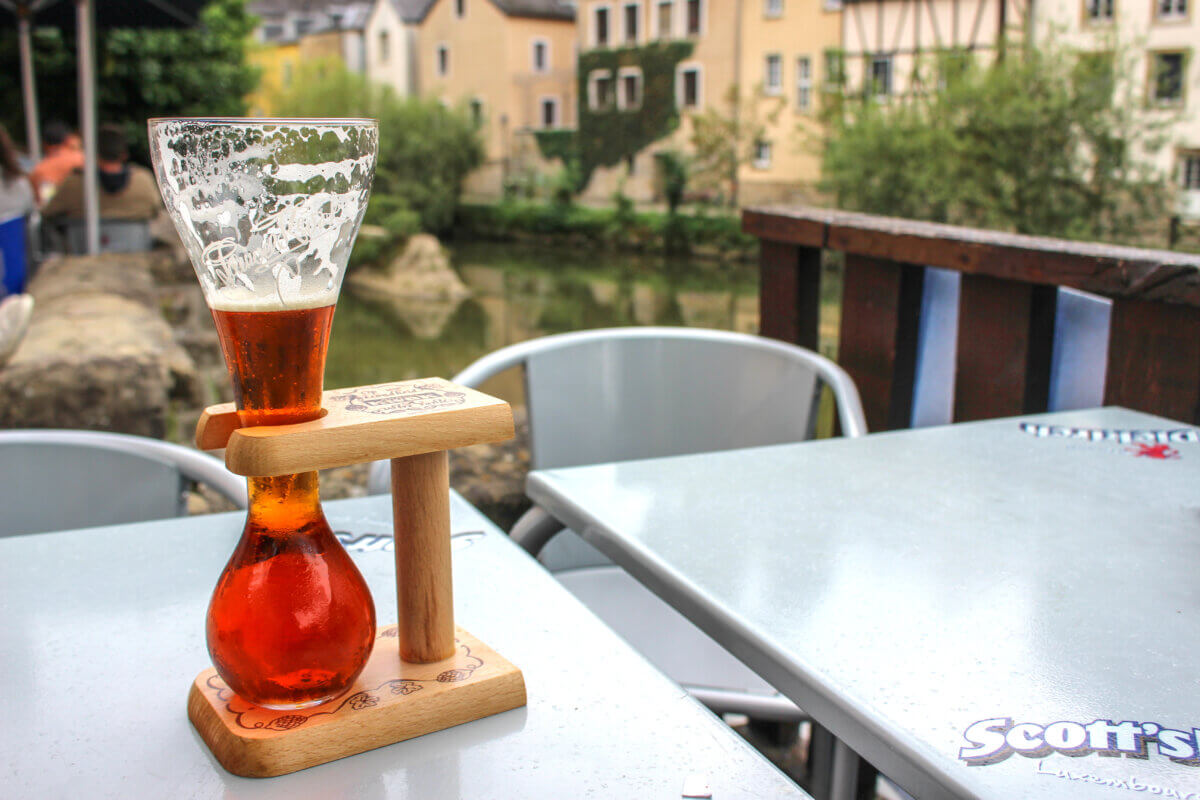
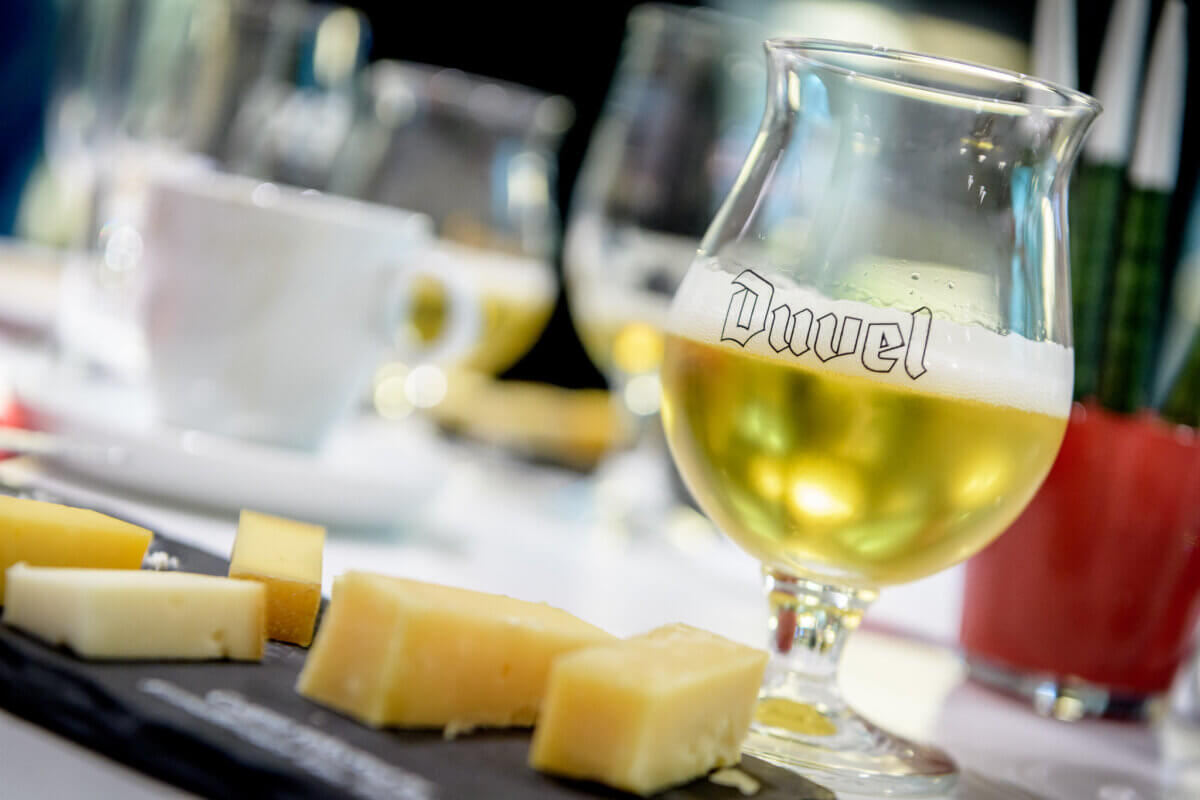
“Our most important drink remains beer, a product that has been part of our tradition for centuries. In Belgium, hundreds of different beers are brewed in nearly every city. Belgium is also known for the Trappist beers, brewed by monks in monasteries, a tradition that dates back to the Middle Ages, when abbeys became important centres of knowledge about agriculture and crafts.  In Belgium, beer doesn’t only come with diversity and quality; it also represents a culture in itself, each beer being served in its own particular glass. Belgium is not a large producer of wine, although we drink it commonly and use it regularly in our cuisine as well. In the last decade, we have also seen an increasing production of Belgian sparkling wines, which have achieved high scores in international competitions.”  
©SPFAE Grand Place ©Shutterstock.com

“As far as food is concerned, its specificity is difficult to summarise in a few lines, as there are so many recipes and traditions, although Belgium has only 11 million inhabitants. Eating, and cooking, is really part of our way of life and each family will have its own secret recipes.”

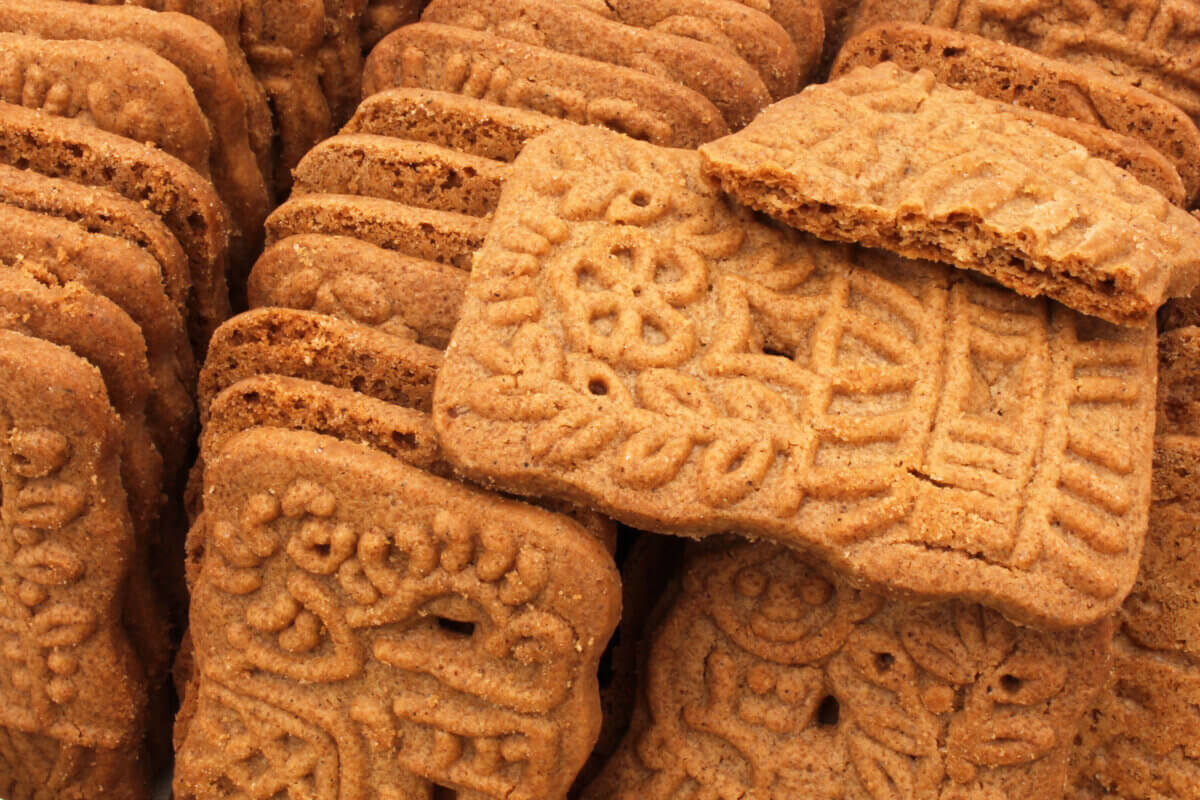
Sharing with our readers some typical Belgian secrets, Ambassador Sibille elaborated, “The first secret is the sweet note we end dinner or lunch with. Not only do we have a dessert but also we usually have a little chocolate (the famous praline) or a nice biscuit – often a speculoos, a cookie made with cinnamon and the typical brown sugar of Belgium “cassonade” - with our coffee or our tea afterwards.

The second one is how we celebrate every opportunity with food: we have many festivities around the year, from Epiphany (6th of January) to Easter, Saint Nicholas or Christmas. Each one of them is accompanied by a different culinary speciality, which may vary from one city to another. Some of them are only eaten once a year on that special day!”

©Shutterstock.com

Key representative Belgian dishes

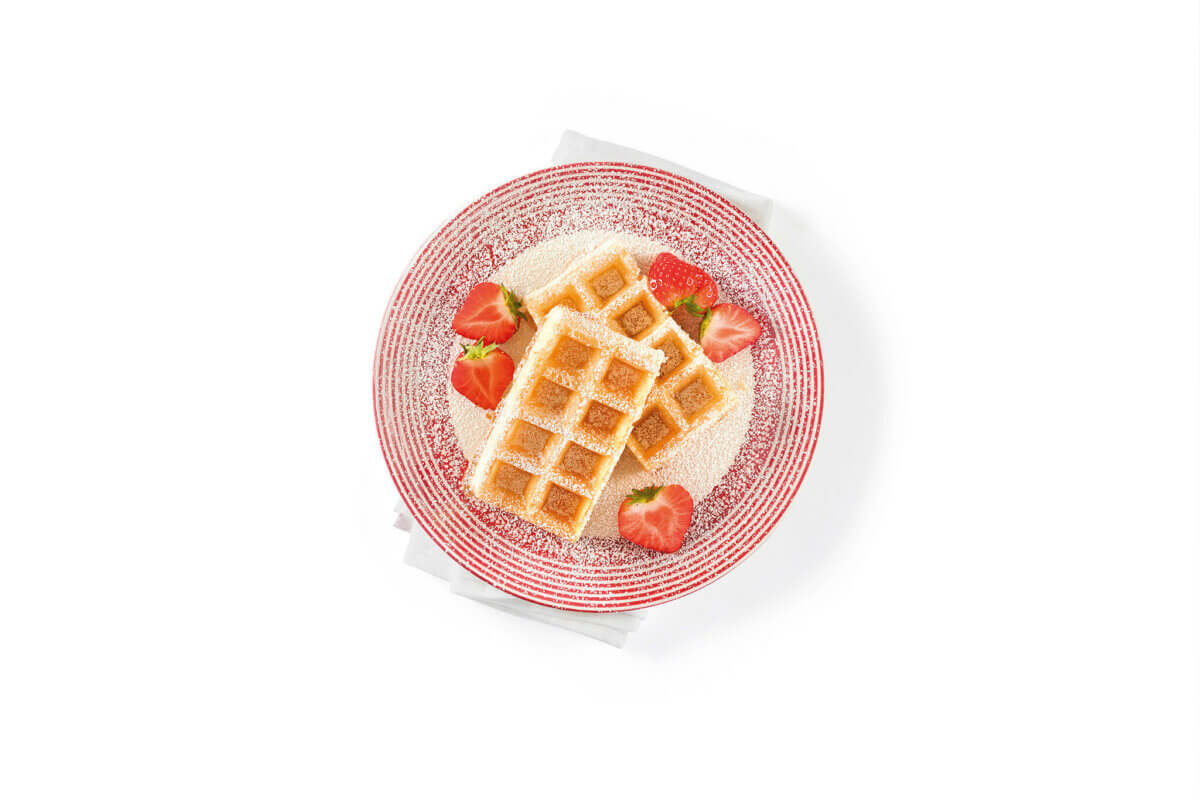
Belgium is known for its waffles. But outside of Belgium it is rarely known that waffles come in many different versions. If you want a “Belgian” waffle, you will first need to decide if you want a waffle from Brussels, light and crispy, often eaten with whipped cream and fruit, or one from Liège, a waffle with a special kind of sugar, which is eaten very warm. These two varieties are the most well known, but many more exist. 
©Shutterstock.com ©visitflanders.com

A simple but very typical Belgian dish is the “steak tartare”. It is made up of good quality minced raw beef, mixed together with mustard, shallots, pickles, capers and some herbs and spices. The Belgian version of the dish is usually served with mayonnaise and Belgians call it an “American filet“ (it has nothing to do with America but that doesn’t matter!). Of course, they serve it with fries. Or Belgians just eat it on a sandwich, as a quick lunch, on a working day.

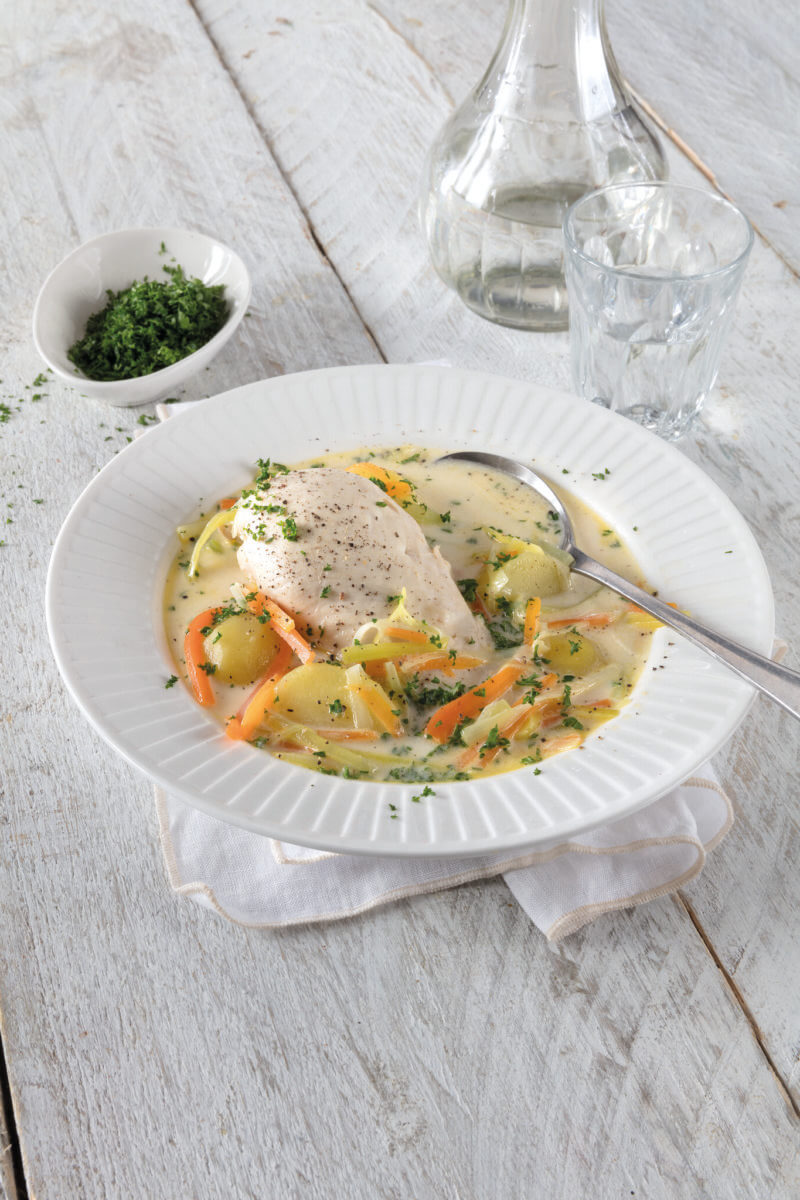
Another typical Belgian dish is the “waterzooi”, a soup made with chicken or fish, according to your taste, cooked with vegetables (usually carrots, celery and leek) and potatoes, and thickened with cream. It originates from the city of Ghent and was traditionally served with fish, although it is more often made with chicken today.

Flemish stew, a beef stew slowly cooked with dark beer, is another common Belgian recipe. Traditionally it is cooked with special syrup from Lieges, creating a sweet and sour flavour. In Belgium, it would typically be served with mashed potatoes or fries.

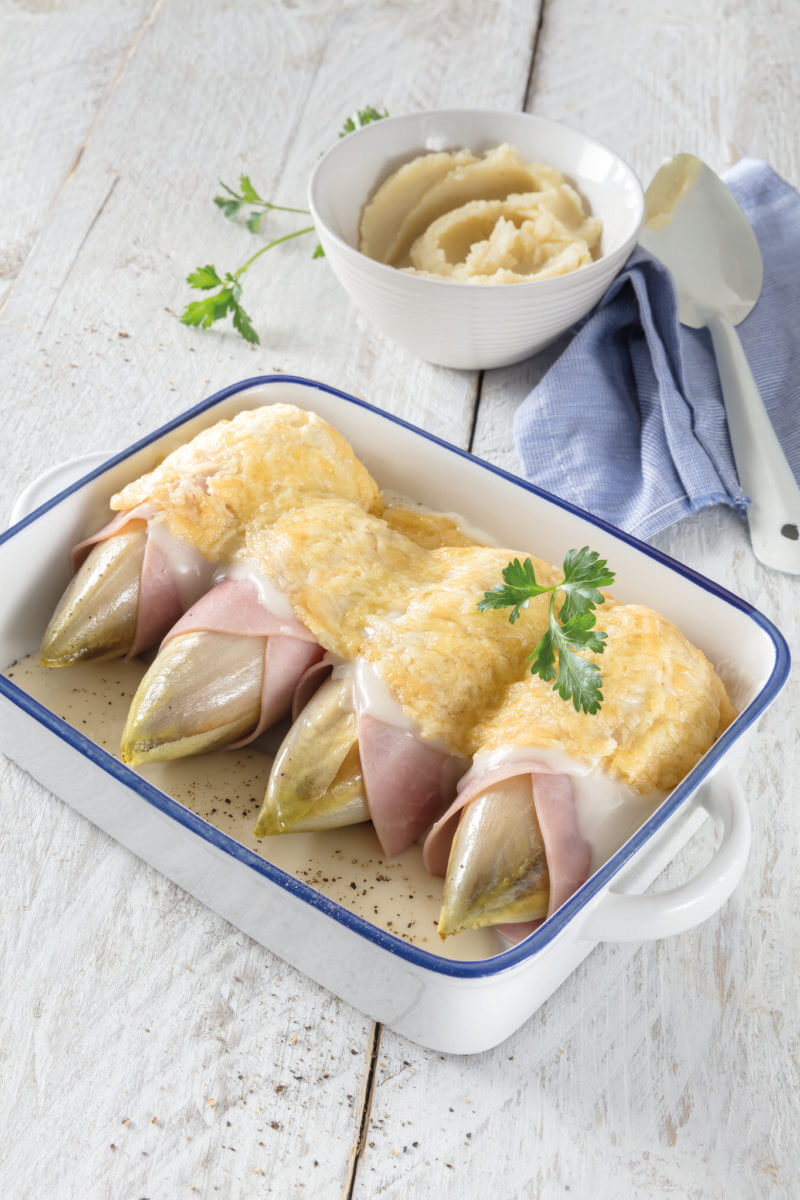
In another family recipe, some Belgian endives wrapped in ham and cooked in the oven with a white sauce usually do the trick. It is a very traditional family dish. For children, who usually do not like their bitter taste, the endives (Belgians call them “chicon” in French or “witloof” in Dutch) can be replaced by leek.

For dessert, what about a “chocolate mousse”? The Belgian recipe is usually very light, without cream or milk, focusing on the taste of the dark chocolate mixed with whisked egg whites.

Maybe, as a last one, amongst many more specialities to be explored by our readers, is the Dame blanche or “white lady”. A very simple recipe, made of vanilla ice cream (advised for a homemade one by Ambassador Sibille) covered with a hot chocolate sauce – made with Belgian chocolate of course. “For those with a sweet tooth, I would further advise to add whipped cream and some crushed speculoos on top! Easy and delicious for children and adults alike!”

As our interview drew to a close, Ambassador Sibille shared for the most curious of our readers and the food lovers amongst them, some interesting websites where you can find recipes:

https://walloniabelgiumtourism.co.uk/en-gb/3/i-love/food-and-drink/chefs-recipes

https://www.visitflanders.com/en/themes/flemish-food/flemish-dishes-and-specialities/flemish-dishes/

https://visit.brussels/en/article/do-it-yourself-gastronomy-cooking-brussels-style

Enjoy discovering Belgian cuisine!

©visitflanders.com

0 comment
0 FacebookTwitterPinterestEmail

by Kathleen Pokrud, President of Hong Kong Ladies’ Group

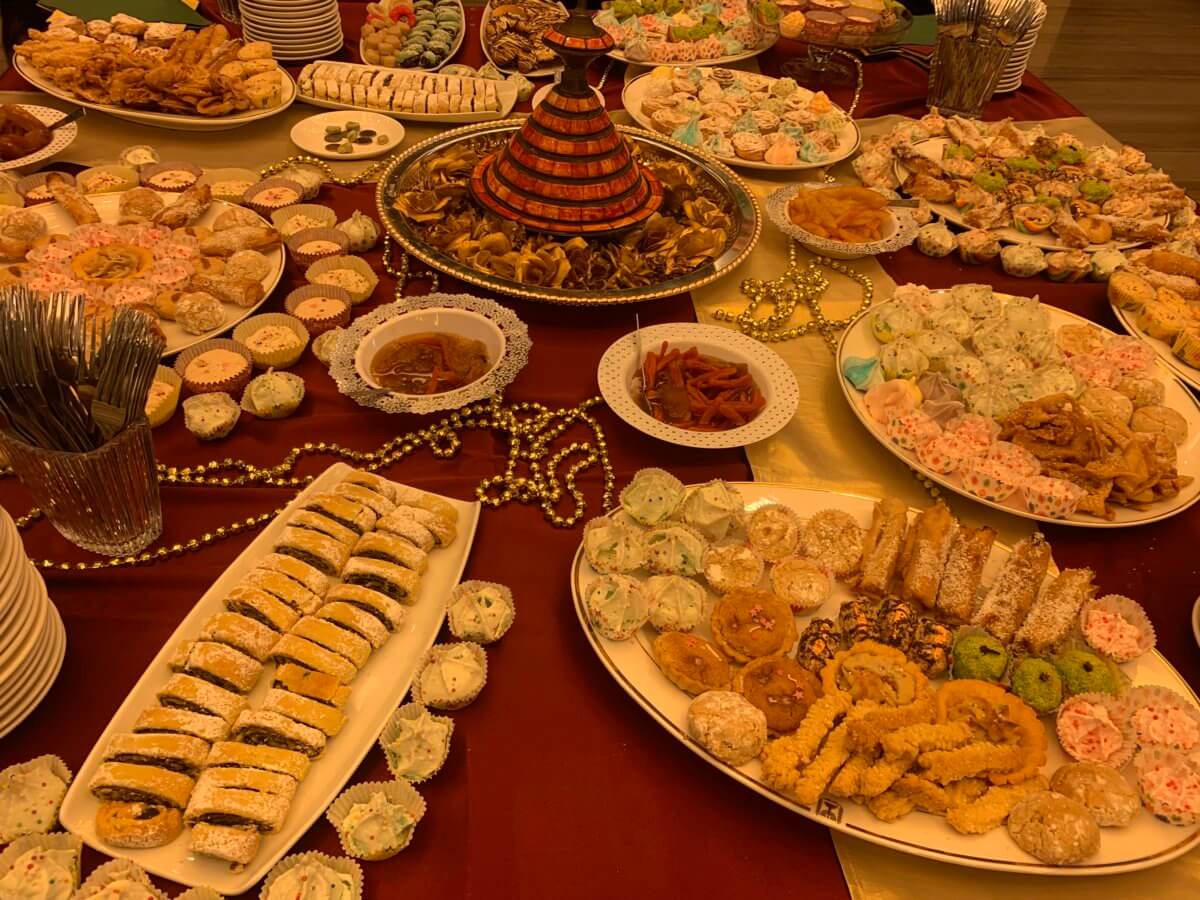
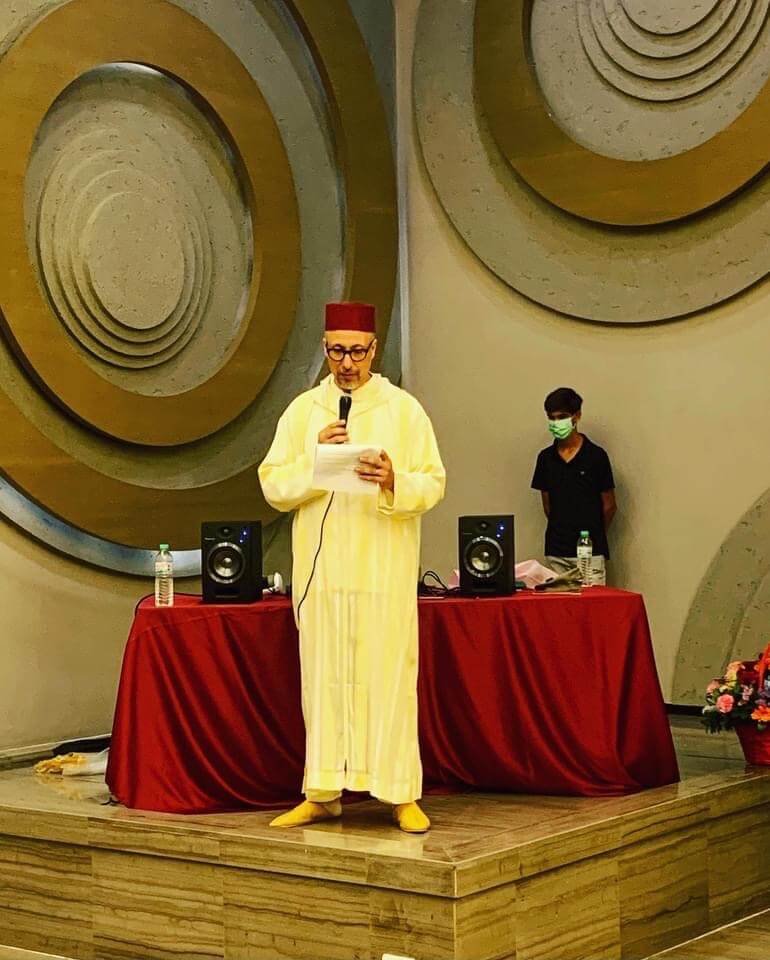
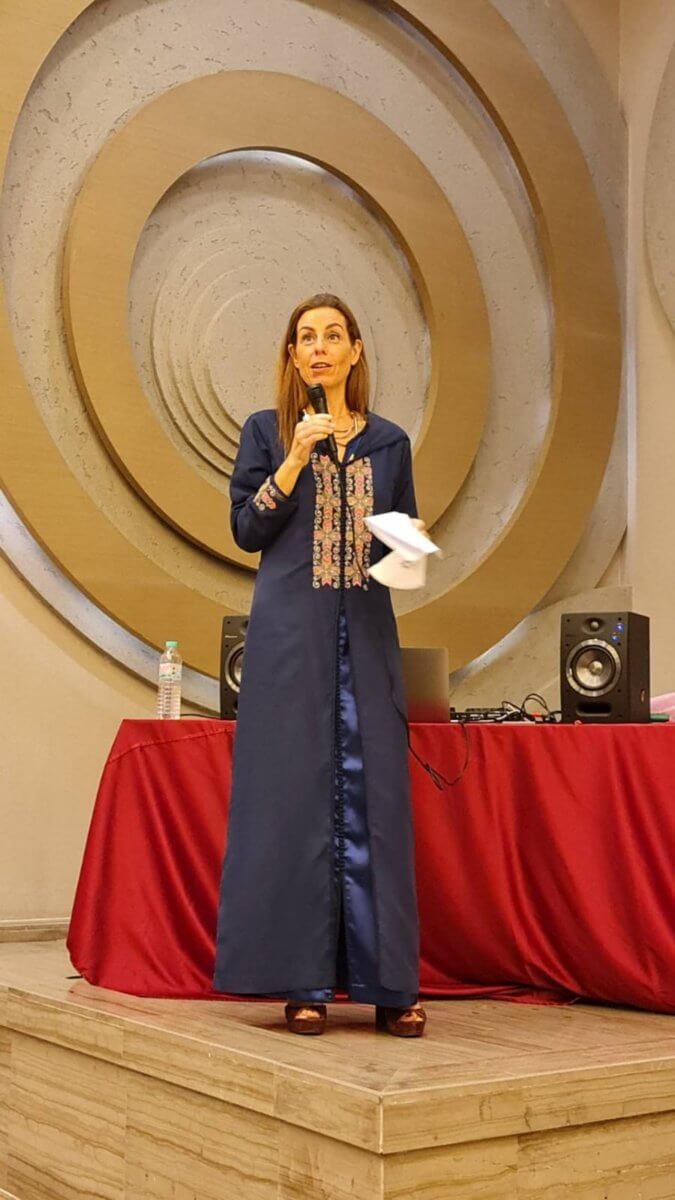
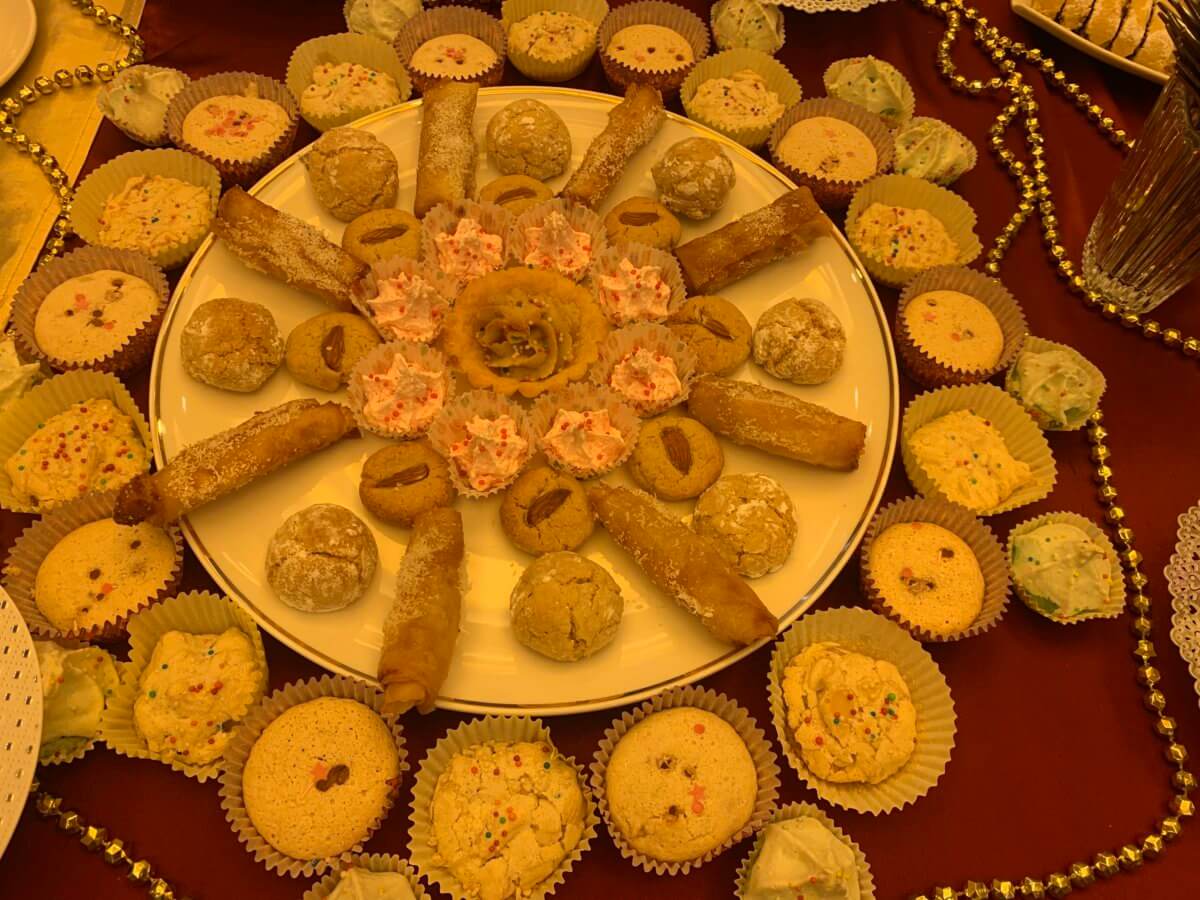
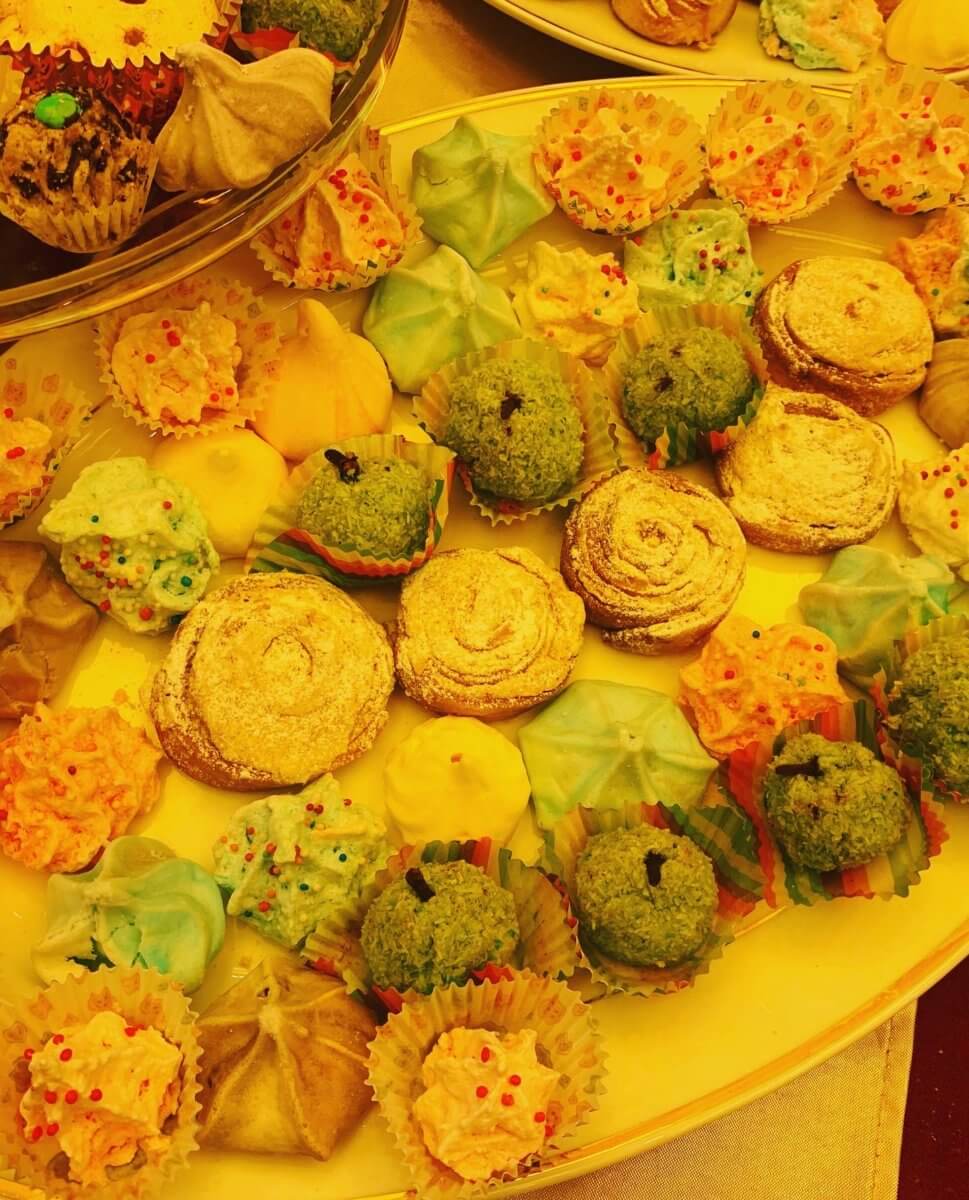
The Embassy of Israel and the Embassy of the Kingdom of Morocco recently organized the first-ever joint Moroccan-Jewish celebration of Mimouna in Bangkok. The event was held at the Residence of the Ambassador of Israel. The special cocktail-style party was significant following the normalization between the State of Israel and the Kingdom of Morocco in 2020. The guests experienced the joy of Jewish-Moroccan food, sweets, music and colors.


The Embassy of Israel and the Embassy of the Kingdom of Morocco recently organised the first ever joint Moroccan-Jewish celebration of Mimouna in Bangkok. The event was held at the Residence of the Ambassador of Israel. The special cocktail style party was significant following the normalisation between the State of Israel and the Kingdom of Morocco in 2020. The guests experienced the joy of Jewish-Moroccan food, sweets, music and colours.

Mimouna is a unique tradition celebrated by the Jewish community in Morocco. It is held the day after Passover (Pesach in Hebrew). Passover is a major Jewish holiday that celebrates the exodus of the Jewish people from slavery in Egypt. During the Passover, the Jewish people avoid anything that contains grain that has risen or fermented, for example breads, pastas, beers, liquors, etc.

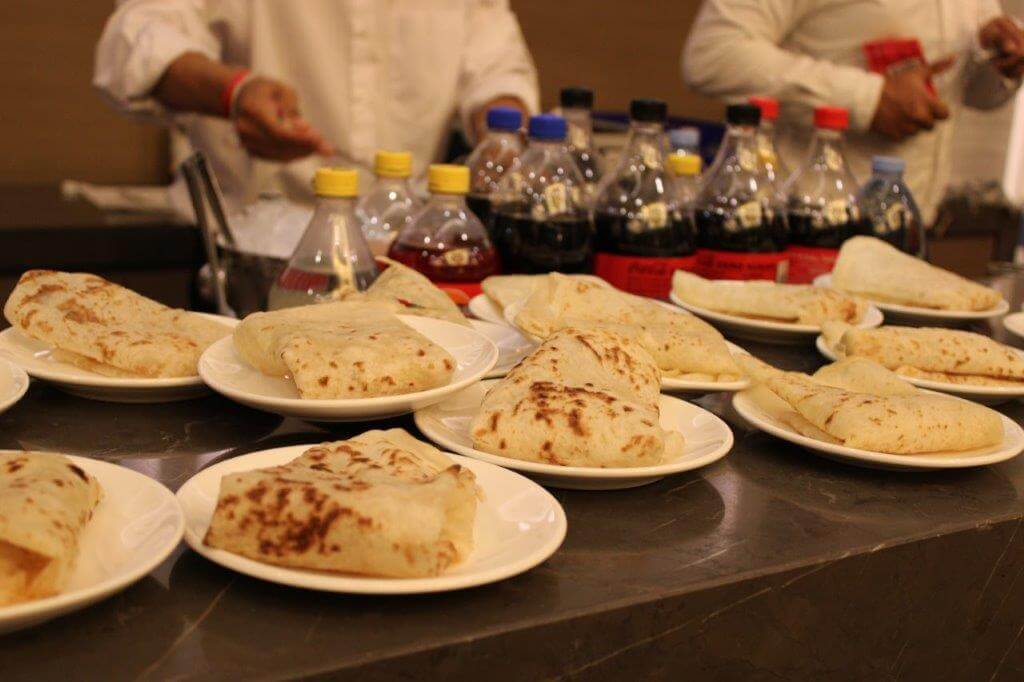
Mimouna marks the return to eating food that is forbidden throughout the week of Passover. Traditionally, Jews in Morocco held an “open house” for all their friends and neighbours to come and go between the various celebrations. The celebration has special sweets; including Mofletta, which is a thin crepe made from water, flour and oil, usually eaten warm with honey.

In the welcoming remarks, H.E. Mr. Abderrahim Rahhaly, Ambassador of His Majesty the King of Morocco to the Kingdom of Thailand, offered the special greetings of these celebrations “Trabhou w tsaadou” or in English “May you have success and good luck”. “Mimouna is a unique Moroccan Jewish tradition that marks the end of the Jewish Passover, through which the Jewish community enjoys moments of joy, happiness, friendliness and sympathy. It is a particular celebration in the Kingdom of Morocco, which shows signs of religious tolerance, acceptance and respect. It reflects the particularity of the presence of the Jewish community at the heart of a Muslim majority country.”

H.E. Ms. Orna Sagiv, Ambassador of the State of Israel to the Kingdom of Thailand agreed,
“It is clear that The Mimouna party took place two years after normalising relations between the State of Israel and the Kingdom of Morocco. It is truly a new era of friendship, which is just the beginning of working together. So we look forward to seeing more projects and collaborations, that will be held in the future.”

The event was well attended by international ambassadors and business community. To signify the cooperation, the two Ambassadors, Ms. Orna and Mr. Abderrahim joined hands to help making the snacks used for the celebrations feast.

Recipes for some popular and favorite sweets served during Mimouna

Moroccan Mofletta

Ingredients:

1 kg. White flour

1 tablespoon Sugar

1 teaspoon Dry yeast

1/2 teaspoon Salt

3 cups Water (if necessary add another half cup)

Oil for dipping the dough balls

1 tablespoon Vinegar

1/2 teaspoon Baking soda

Preparation

  1. At the bottom of the bowl, sprinkle the salt, pour the flour over it and the yeast and sugar over it.

Pour in the water gradually and as needed and begin to knead until a nice, uniform dough is obtained.

2. Divide the dough into balls the size of a ping pong ball, dip each in oil and place on a tray or pan to rest

for 15 minutes.

3. On a greased surface open the first ball with your hands to a dough sheet as thin as possible.

Place on a hot pan and meanwhile open another dough ball.

4. Turn the first moflet after about 2 minutes, place the new moflet we opened on top of it and

turn over and place a new muffle again. Continue like this. Every 10 escapees start a new pile.

Homemade Marzipan

Ingredients:

200 grams bleached almonds (or ground bleached almonds, ground on the spot in a spice store)

80 grams (two-thirds cup) powdered sugar, sifted (refined sweetness, can be increased by a few tablespoons to taste)

½ teaspoon freshly squeezed lemon juice

20-30 ml. (a tablespoon and a half to two) water, as needed

About half a teaspoon of quality almond extract, or to taste (or 5-10 grams of bitter almonds)

Preparation:

  1. Grind the blanched almonds well in a food processor to crumbs as thin as possible-

The mixture will still remain a little crumbly at this point and grind thinner after adding the powdered sugar.

If bitter almonds are used, grind them together with the bleached almonds.

  1. Add the powdered sugar and grind well to a fine powder - even if you stay in the finished marzipan
  2. A few thin crumbs is fine, but be careful not to leave almond crumbs too large and uneven.


Coconut Meringue Cookies

Ingredients:

4 cups ground coconut

8 units of protein

3 cups sugar

2 bags of vanilla sugar

Pinch of salt

Some colored candies for the cake, for decoration

About 50 cuff units

Preparation:

  1. Put the proteins in a large bowl with a pinch of salt and beat. Gradually add the sugar and vanilla sugar, whisking. Continue to whip until you get a steady pace.
  2. Whisk for about 15 minutes, until the sugar melts and the foam is stiff.
  3. Add the coconut and stir well, simmer for 20 minutes.
  4. Transfer the mixture to a perfusion bag with a large star-shaped mouth-shaped catheter, and infuse in a rotary manner into the cuffs. Sprinkle a little candy for decoration.
  5. Bake for about 20 minutes at 150 degrees, until the cookies harden and turn slightly golden. Cool and place in a storage box.


0 comment
0 FacebookTwitterPinterestEmail

by Khun Shaklunta

CLB in the pictures: Shakun Gurbani, Jindarat Jhumsai Ns Ayudhya, Esperenca (Hope) Pilunthanakul, Kathleen Pokrud, Siti Survo, Nancy Bathan Lewis, Ronelle Stoessel, Fernanda Pungs, Tetsuko Wilberg
Sending you pictures of CLB-Cosmopolitan Ladies of Bangkok lunch gathering on Friday, April 29th. We discovered a nice restaurant with ambience atmosphere resort style called Baan Suan Sathon Cafe’.
0 comment
0 FacebookTwitterPinterestEmail

by Kathleen Pokrud, President of Hong Kong Ladies’ Group

Photos by Jenny Chan

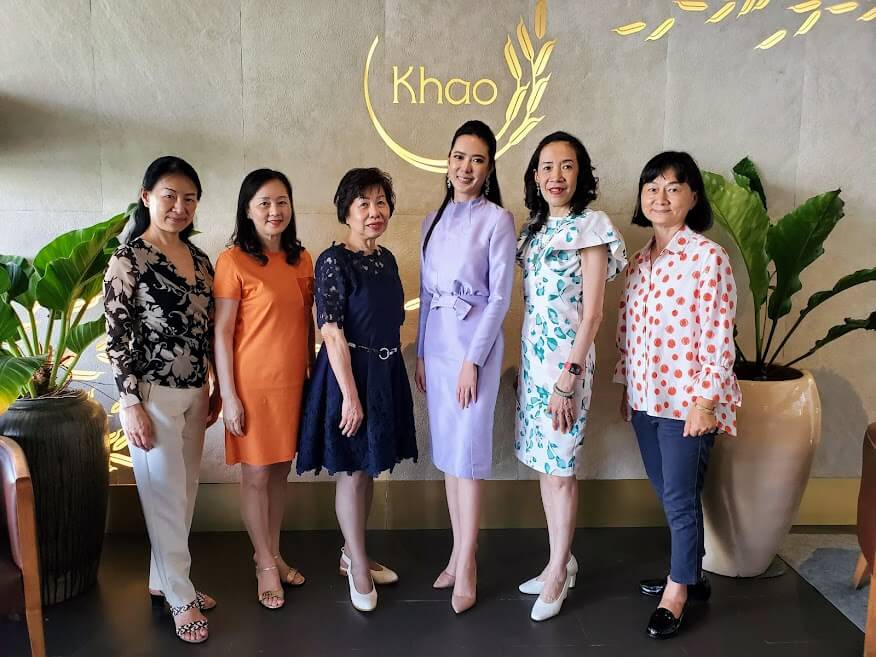
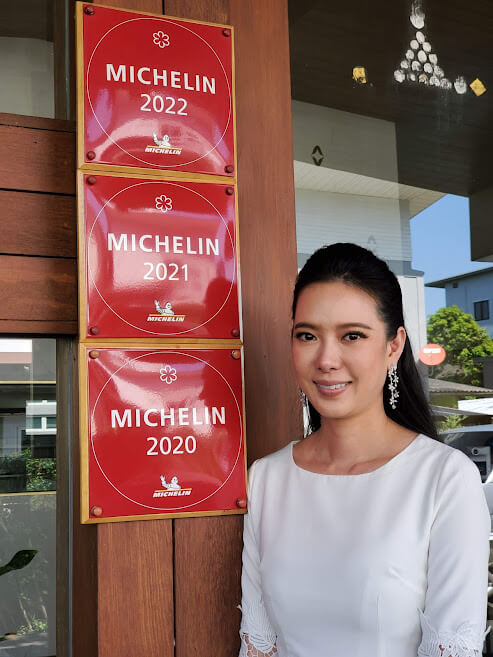
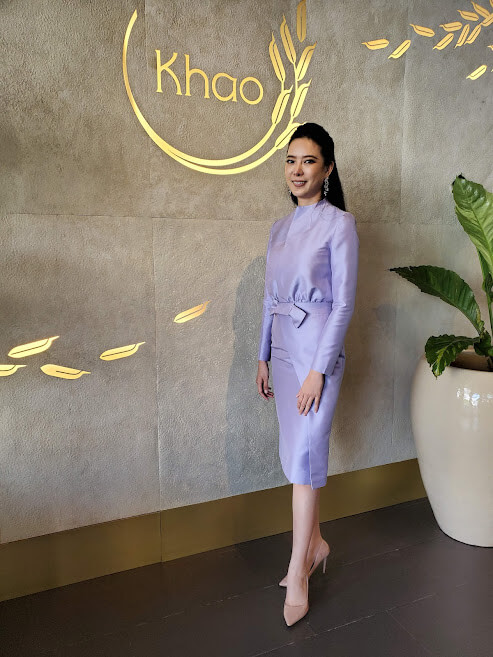
It is easy to say, “Follow one’s childhood passion or dream”, but in reality how many manage to do so. Another question is “Will one recognise the opportunity to fulfil your passion when it comes?” Expat Life was so impressed to come across such a case and find inspirations for our readers. I sat down with Pradinan Arkarachinores, the beautiful and elegant owner of Khao, an awarded Michelin star Thai fine dining restaurant since 2020 for three consecutive years. A private banker turned entrepreneur, to learn about her journey in fulfilling the childhood fantasy into concrete achievements. A collector of over 2,000 cookbooks in both local and international cuisines since childhood must be passionate about cooking and food.

Khun Pradinan was raised in Chiang Mai; very typical Chinese households at the time, when children were not distracted, like the present time, with iPads or iPhones. She recalled her early years, “I grew up learning that we have to work to earn money. Yes, I was given pocket money to go to school. On weekends, when I helped my aunts with their business, I felt very proud to earn my own extra money, even for only 20 Baht. As a daughter, I was raised to be familiar with domestic chores such as helping my mother in the kitchen. My father would on the other hand, took me to all his business meetings, so I was exposed to adult business conversations at a young age.”

She moved to Bangkok at 15 and graduated with the Bachelor Degree in Economics from Thammasat University. Upon graduation, she started her wealth management career in the banking industry, in local and international environments. Aside from Thailand, the professional banker has posted 10 years in Hong Kong and periods in Singapore. Simultaneously, she continued to fulfill her passion for cooking. In 2009 – 2010, between career moves, she enrolled with Le Cordon Bleu Bangkok. Started with two basic courses in pastry and cuisines, she ended up spending 1 million Baht to complete the intermediate and superior courses.

Recalling how she fell in love with food or passion for cooking, Pradinan’s eyes lit up and shared, “I was fascinated with the appealing presentation of dishes from the cookery books I love to read. They were so pleasing and much different from our own home cooking. When relatives gathered during the festivities, we cooked together a lot among the extended family. For me, as a 7 year old, helping out in the kitchen was a game of fun. My toys were the ingredients that I played around with.”

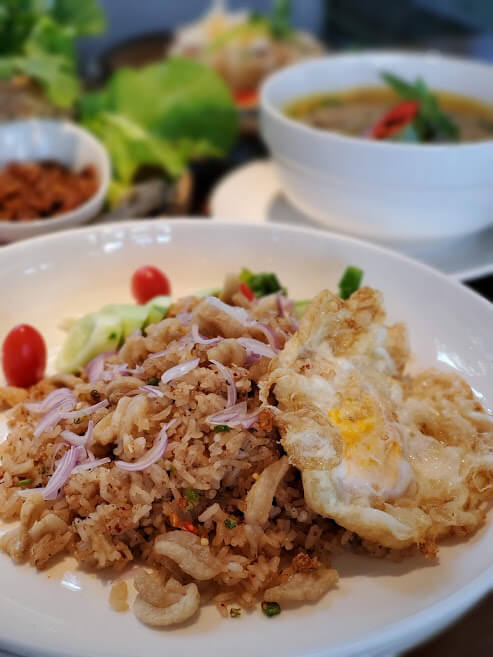
I asked Pradinan if she had any particular fond memories in the kitchen. She pensively smiled, “I lied to my mother when I was very young, naughtily cut my finger when playing with the knife chopping bamboo shoots. I told her it was a thorn from the rose garden. Another memory I treasure every year was the New Year. My mother would make fruitcakes as gifts to our friends and neighbours. I loathed whipping the egg white but loved to cut the nuts. In the old days before all these readymade curry sauces in the supermarkets, we have to make our homemade sauces. One of the dish that I serve in my restaurant “Fried rice with black chilli paste” is one of my original family’s recipe which I modified”.

None of her family members have owned a restaurant; Pradinan is the first one in the family while holding a full time job as a banker. What inspired her to take the risk as an entrepreneur, and above all with restaurants, which rely on hardware, right venue and equipment; and software, meaning people. Restaurant operation is a labour intensive endeavour. She answered with conviction, “As a private banker, everything is about attention to details when I deal internally, externally with my clients or with people that work for my clients. In addition, there are many issues that are time sensitive. I do not see any difference in applying this knowledge to the restaurant business. I can say that I love doing both in parallel.” She paused briefly and elaborated further, “It is like I have two channels of radio frequencies working separately on my professional career and my commitment to Khao. The two businesses are in different compartments, and I can direct my energies into both without interfering one another. I do not see either one is tougher than the other because I can disjoint to handle their own details.”

Pradinan took over Khao from the previous owner in 2018. She strongly believes that success does not depend on luck, but by genuine hard work, and recognising the right opportunity that comes along. “I chose to invest in an existing business because at that time, I was working full time in Hongkong. It would be a wiser move to take over a working operation rather starting out from scratch. In 2019, The Michelin Bib Gourmand awarded Khao as “good quality, good value restaurants”. The following year, we earned our first Michelin star as the ultimate hallmark of culinary excellence, which we have held until now in 2022. The obstacles that I encountered along the way seem countless at times. I believe that my strong team has helped me through the years. I also had to contribute tremendously effort in motivating them, and earning my respect. At the beginning, many were skeptical that I only wanted to own a restaurant in name only.”

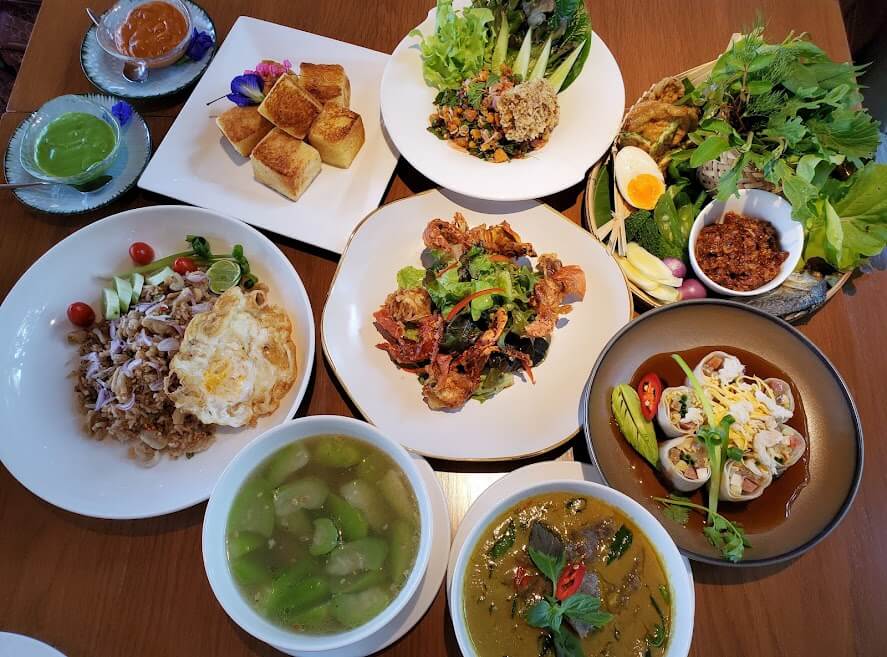
Disclosing on the factors that have contributed to the success of Khao, “I have a crystal vision what I wish Khao to be. It is to be a Thai restaurant where Thais go. A good example is it is the place that overseas Thais returning home, and enjoys all the dishes that they miss while abroad, or real Thai recipes that they grow up with. My focus is on age old or lost recipes that we can find in Thai literature. I understand that some restaurants like fusion experimental tasting menu for photogenic instagram purposes. This is not what we pursue in Khao. Our chefs team is very motivated to learn and has clear direction on what we want to serve. We strive to present the best version of the original recipe to show the delicacy of our Thai cooking culture. Some dishes do not have recipe available but they are written in old Thai books. Shrimp paste soup is one of the dishes that I offer in Market Café by Khao at the Hyatt Regency Sukhumvit. We have to reconstruct this recipe with a twist in the ingredients while maintaining the quality.”

What next for Khao? The original branch of Khao is located on Soi Ekamai, which focuses on original Thai recipes. Pradinan was heavily involved designing the menu for the second branch at Hyatt Regency Bangkok Sukhumvit on Soi 13, which goes by the name The Market Café by Khao. The restaurant turned into a more fashionable venue and fine dining concept, serving dinner with age old recipes. She admitted that some of the dishes were adjusted 10 times to grasp the taste, and many more amendments to reach the ultimate version agreed by the team. It took six months to finalise the menu. Soon to be opened is her third branch in Central World on the 7th floor. She excitedly reviewed, “The new concept is “Khao’s favourite dish”. I want the new branch to embrace both Thai and international food. Many of us in Thailand grow up with popular Western menus like French fries, baked clams in butter or even spaghetti bolognaise. This will be the venue for families to enjoy where parents order the dishes they grow up with and share with their children. Youngsters can hang around and enjoy group feasting. Foreign visitors will find real Thai dishes where Thais go. In the pipeline, Khao is expanding to offer readymade sauces to be available in the retail market. With my years spent in Hong Kong and Singapore, it is my next dream to bring the concept of Khao to these two vibrant cities.”

As our time drew to a close, I was impressed with how Khun Pradinan was so very composed and cheerful throughout the interview. Her boundless confidence in dealing with business obstacles as she puts it, “I do not worry, nor feel stress or complain being tired. I would like to share with the Expat Life in Thailand readers, especially women entrepreneurs are to be on the alert, when opportunity comes knocking at your door, seize the moment and take the plunge.

I did when I acquired Khao and have not regret any minute of it!”

0 comment
0 FacebookTwitterPinterestEmail

Author  by Kathleen Pokrud 

Photo credit by Jenny Chan and Teresa Biesty 

When Kathleen Pokrud approached the embassy with the idea of publishing an article on Peruvian gastronomy, my wife and I were delighted to offer our immediate assistance, especially since the great rise of Peruvian cuisine in recent years has already made it a world reference.

When thinking of Peruvian food, the dish that will probably come to many people’s minds would be the famous ceviche. However, Peruvian cuisine has so much more to offer. The gastronomy of Peru reflects the wonderful biodiversity of the country: 84 of the 103 life zones on the planet are found in Peru. Separated by geography into three regions —the Andes highlands, the Amazon jungle, and a 3,000 km long coast to the Pacific Ocean— and with influences from European (mostly Spanish, Italian, and French), Asian (especially Chinese and Japanese), as well as African cultures, each of our dishes offers a unique history and distinctive flavors.

One of the staples of Peruvian cuisine is potato, one of the greatest gifts of ancient Peruvians to the world; 99% of potatoes cultivated worldwide can be genetically traced back to the Andes Mountains. Today, Peru has more than 3,500 varieties of potatoes, the largest in the world, and Lima is headquartering the International Potato Center.

In the last 30 years, there has been an increase in the popularity of many traditional and new Peruvian dishes. This boom is due, in large part, to the figure of a group of Peruvian cooks led by Peruvian chef Gastón Acurio and his belief that Peru is a “…great nation, with a great living culture, the result of centuries of métissage, and it is precisely this miscegenation that has made our cuisine a varied and diverse proposal that has finally captivated the international public”.

Today, Peruvian cuisine is recognized by the world, with many Peruvian restaurants included on the top of the World’s 50 Best List. In addition, Peruvian embassies all around the world are actively promoting the brand “Super Foods Peru” which consists of produces -capsicum, fruits, vegetables, grains, herbs, roots, and fish- that are exceptionally high in nutrients. Some of that Super Foods Peru is not well known yet in Thailand, while others, such as quinoa, blueberries, grapes, and avocados, are our important exported products to Thailand. Additionally, Pisco, the spirit of Peru, is another flagship product that Peru offers to the world.

I want to thank Kathleen for her initiative and hope that the article below will be an appetizing introduction for its readers to the fantastic and tasty world of Peruvian cuisine.

HE Fernando J. A. Quiros Campos

2017-2022

Ambassador of Peru to the Kingdom of Thailand

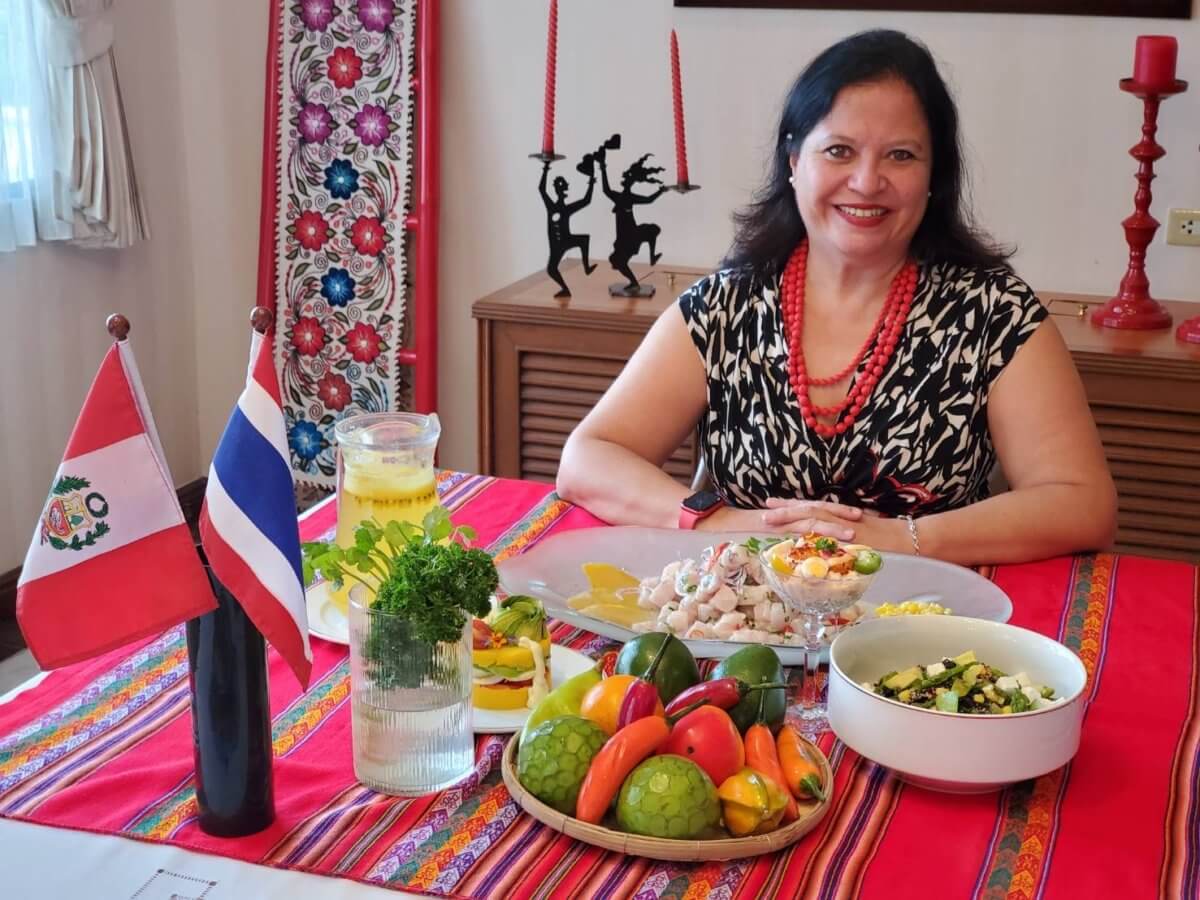
Peruvian cuisine is taking the world by storm with many restaurants in Peru now ranked among the World’s 50 best restaurants. Probably lesser known in Asia, documentaries on Netflix and cable food channels have started to raise awareness of Peruvian food culture. I recently spoke with Madame Ximena Rios Hamann, spouse of H. E. Fernando J A Quiros Campos, Ambassador of Peru to the Kingdom of Thailand, to learn about delicious Peruvian gastronomy.

Peru has been the winner of the World’s Leading Culinary Destination awarded by the World Travel Awards for eight consecutive years, from when the awards were introduced in 2012 until 2019, and in 2021. Our discussions included what makes typical Peruvian dishes so extraordinary and why it has become so popular among foodies as well as the culinary traditions of Peru, its undiscovered cuisine and how Peruvian cuisine is being exported with its cosmopolitan appeal.

Peruvian cuisine reflects the country’s history, with an exclusive variety of dishes. Madame Ximena explained, “The history of Peruvian cuisine dates back to the pre-Columbian, Inca and pre-Inca periods. The Incas are known for their unique agricultural and preservation methods. They developed their skills growing a variety of grains, potatoes, tubers and legumes on terraces, and these farming techniques have influenced Peruvian dishes up to the present. During the Spanish Viceroyalty, the Spanish brought African slaves to the Americas, and over the years, African culture influenced Peruvian culture. The slaves were talented in creating delightful dishes from discarded ingredients, and many of their creations have become well-known Peruvian dishes such as Tacu Tacu, frijol colado, and anticuchos (heart meat roasted on a metal or wooden skewer).”

Madame Ximena elaborated further, “The real gastronomic revolution of Peru arrived from the Far East when immigrants from Asia began to arrive. First were the Chinese, who introduced new frying techniques and ingredients like soy and ginger. Peruvian classic Lomo saltado is possibly where their influence is most evident as it is with Arroz chaufa, a rice-based dish that originated from the fusion of Chinese and Peruvian tastes. Later in the 20th century, when Japanese immigrants arrived to Peru, they introduced ways to prepare and cook fish and seafood, which has been elevated to an art form, as seen with ceviche (Peru’s national dish) and tiradito.”

Madame Ximena proudly declared, “Peruvian cuisine is one of the world’s best. Many dining venues in Peru are ranked among the World’s 50 Best Restaurants (https://www.theworlds50best.com/list/1-50). ‘Central’ in Lima ranks fourth in the world, ‘Maido’, also in Lima, is in the seventh place, and ‘Astrid y Gastón’ is listed 4th in Latin America’s 50 Best Restaurants (https://www.theworlds50best.com/latinamerica/en/the-list/1-10/astrid-y-gaston.html). There is a long list of Peruvian restaurants around the world that are publicized in the Michelin Guide (https://guide.michelin.com/en/restaurants/peruvian).” 

Lima is fast becoming the culinary capital of Latin America and a new global gastronomic epicentre. Peruvian restaurants are mushrooming around the world. Famous Peruvian chefs are building recognition on the world culinary scene. One well-known example is Pía León, who was recently named The World’s Best Female Chef 2021 (https://www.theworlds50best.com/awards/best-female-chef). She is now sharing her country’s flavours with the world.  At the same time, world-class Peruvian cuisine has resulted in an explosive growth of culinary tourism in Peru.

The cuisines of Lima, the North Coast, the Amazon, Arequipa and the Andes as well as Novo-Andean dishes are waiting for every adventurous tourists who comes to Peru. Peruvian food offers spectacular cultural and biodiverse combinations of cooking techniques and ingredients, brought to the land from across the globe during centuries of migration. One would say that the cultural diversity of Peru’s cuisine is what makes it so special.

Peru is a land of unique delicacies with its abundance of extraordinary resources and inexhaustible larder of agricultural products. “Our diet is full of superfoods, exquisite fruits, grains and vegetables - exceptional products that stimulate the palate and wellness of the body.”

Madame Ximena explained, “Peruvian cuisine is also about family, where recipes are prepared by grandmothers who hand them down to mothers or fathers and then daughters and sons. Families tend to meet very frequently and often at a table. La sobremesa, the time after a meal spent at the table, is a precious time as well. It’s the opportunity for everyone to talk, many at the same time, and most probably about food.”

Peruvians possess real talent in conserving their traditional culture while seamlessly adapting to modern culinary styles. Peruvian food is characterized by variety. The more popular world cuisines, like Chinese and French, pose no threat to the diversity and richness of Peruvian cuisine. Madame Ximena explained, “Traditional Peruvian cuisine is Andean food. The most common dish that has been prepared the same way for 500 years is pachamanca. Pachamanca means, “earth oven” in Quechua. It is magic and serves as a tribute to mother earth. What makes it most interesting is its cooking method. First, the “oven” is built by digging a hole in the ground where stones are layered to create a dome shape, and then they are heated by burning logs. After the oven is heated, ingredients are added in layers: first the sweet potatoes, potatoes and oca, and then more hot stones on top, followed by a variety of marinated meats, after which come the beans and guinea pigs (cuy). Then, the oven is sealed with leaves, cloth and soil and left to cook and simmer for around three hours.”

Due to the country’s geographic diversity, traditional Peruvian cuisine can be classified into three main regions: the coast (la costa), the mountain (la sierra), and the jungle (la selva). Peruvian food is often referred to as “Fusion food”, or comida criolla, due to its blend of Spanish, Asian, Incan and other European cuisine influences, which are integrated into the cooking. 

On the topic of modern Peruvian cuisine, Madame Ximena introduced Gastón Acurio, “As one of Latin America’s celebrity chefs, he is one of the most important Peruvian chefs who has contributed to making Peruvian cuisine known worldwide. In a CNN travel interview, Acurio stated that Peru is a mix of indigenous cultures, Spanish colonizers and many immigrants who have come to Peru — Italian, Japanese and Chinese — and our food is a reflection of that”. He famously declared that he wanted “our people to feel that we were not condemned to imitate others’ cultures or others’ cuisines. We have a beautiful cuisine that deserves to be celebrated around the world.”  Chef Acurio has achieved this goal with his empire of over 30 restaurants spread across a dozen countries.

She went on to say, “One of the modern Peruvian fusion cuisines is Nikkei, a combination of Japanese and Peruvian cuisine, using Peruvian ingredients but crafted by Japanese techniques. Peruvian and Japanese cuisine share common ingredients such as rice, vegetables and fish, which help create a natural fusion between the two. Nikkei cuisine a unique blend of meticulousness of Japanese preparation and presentation and the relaxed nature of Peruvian culture.”

“Novoandina is another modern Peruvian style cuisine. Dishes contain traditional, native ingredients such as quinoa, maca and yacón prepared in a modern way. One of the first restaurants to introduce Novoandina cuisine is ‘Las Brujas de Cachiche’ in Lima, which only serves dishes that were originally prepared in the Inca period.”

Popular Peruvian dishes

Madame Ximena recommended, “The most authentic Peruvian specialties are to be found back home. Popular Peruvian dishes are made of four main groups, namely potatoes and roots; fish and seafood; quinoa and other cereals; and ‘cuy’, guinea pig, which is part of our dietary tradition.”

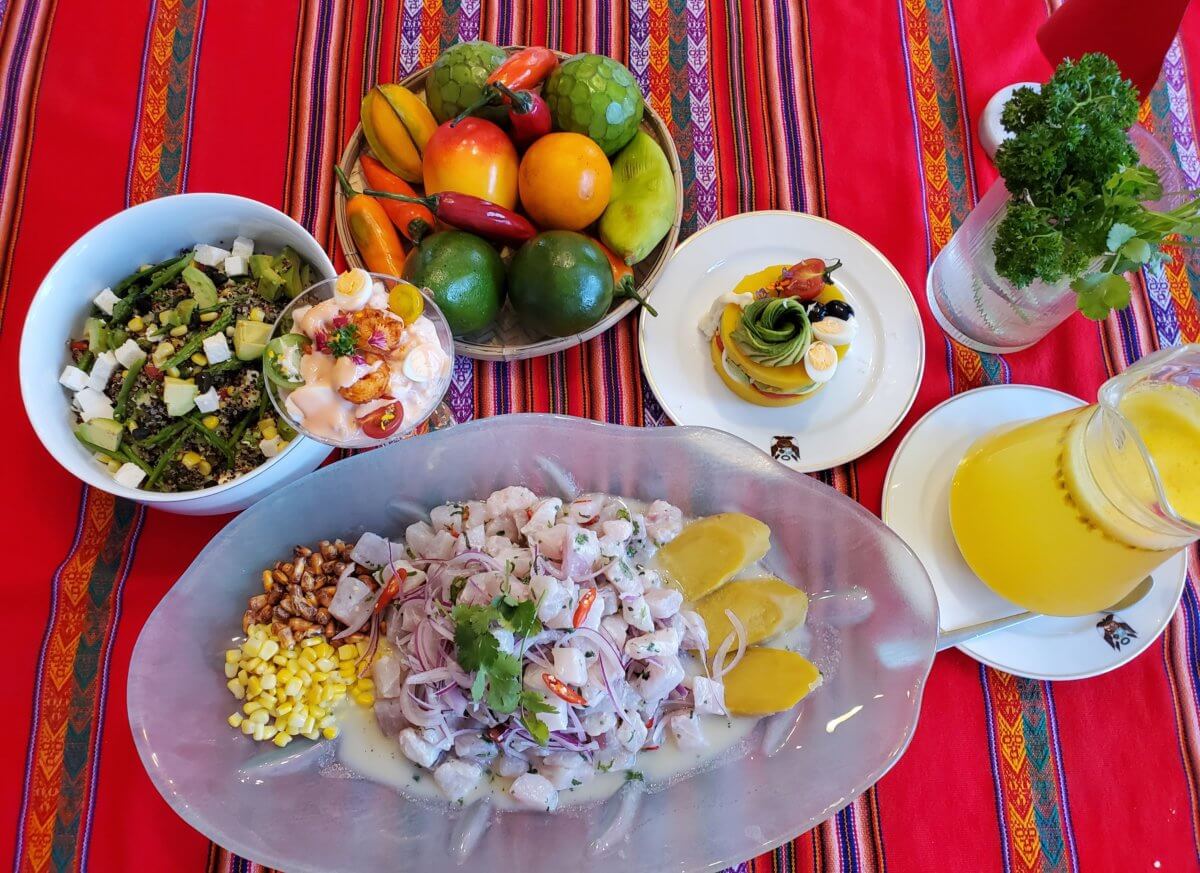
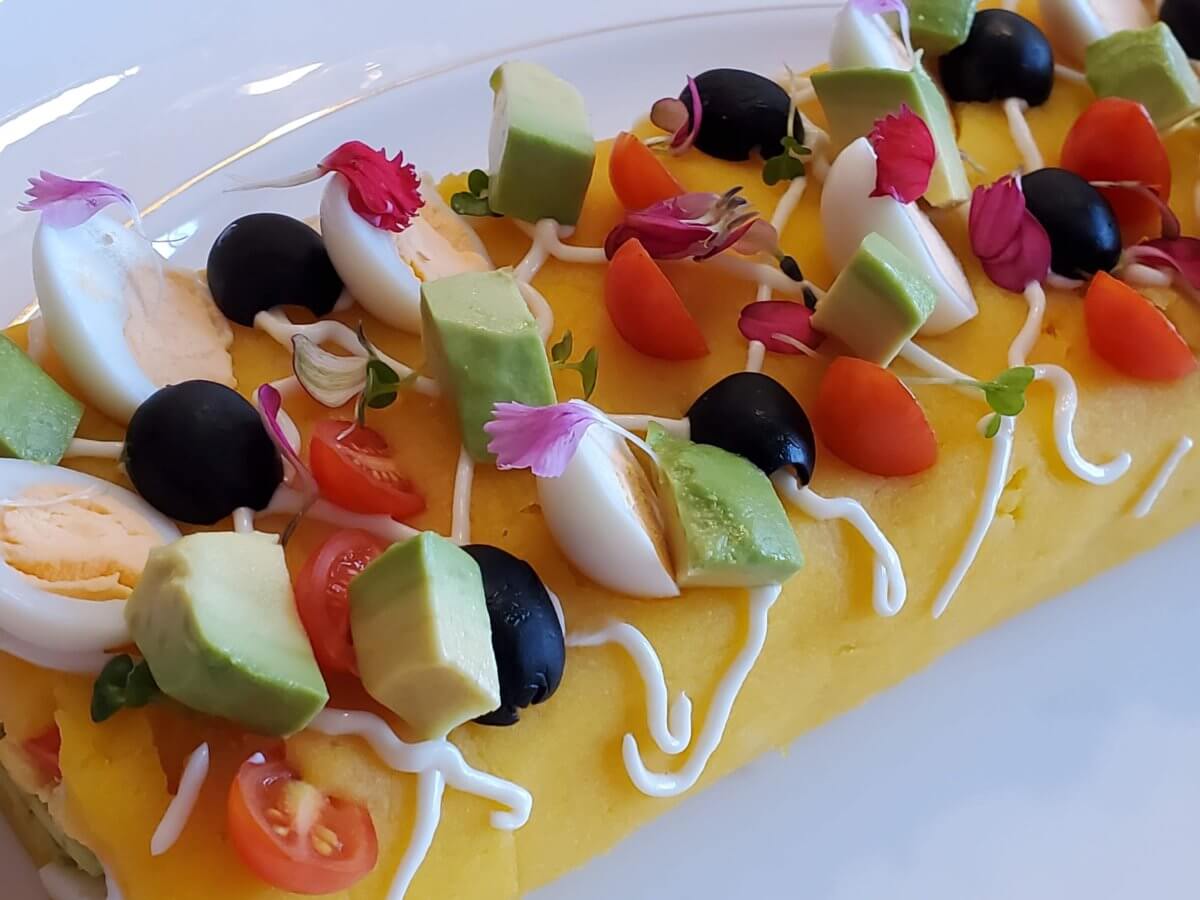
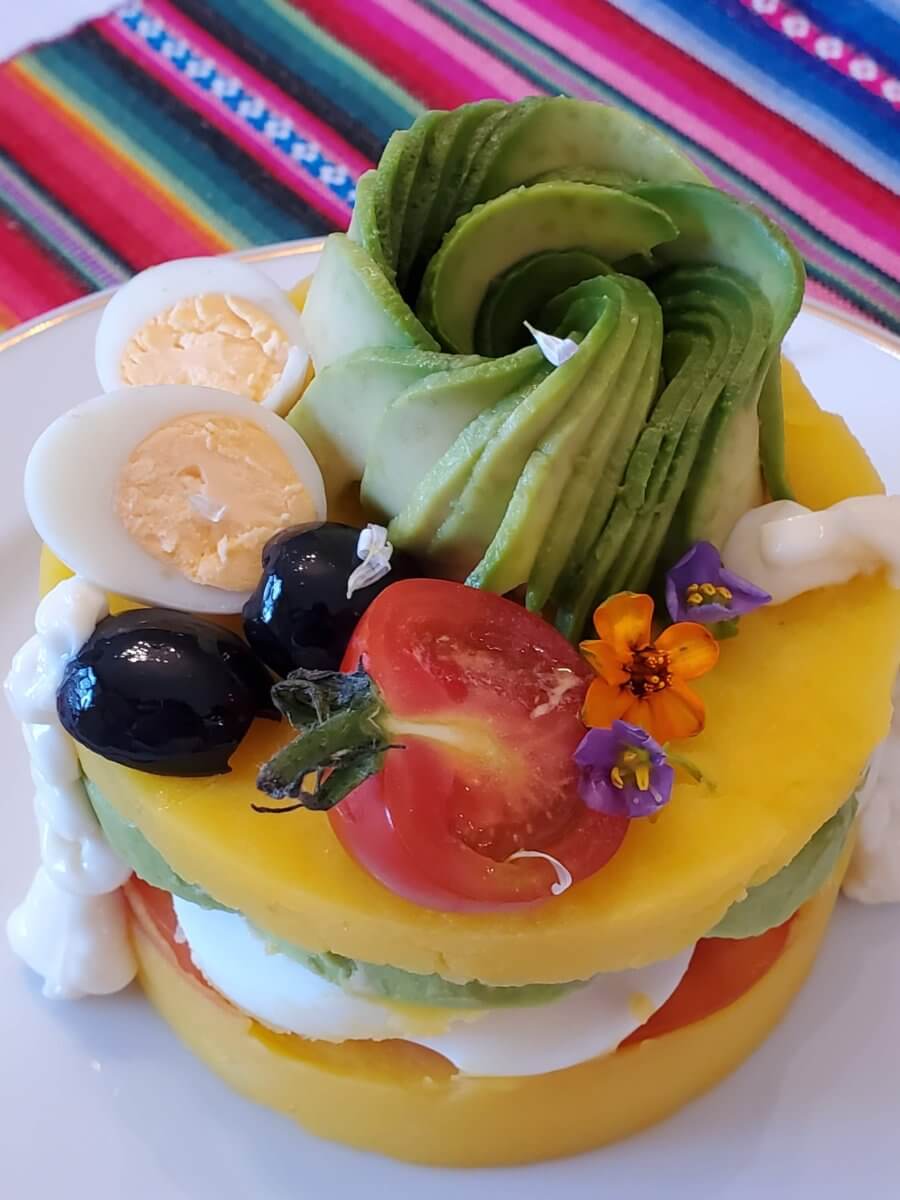
Potatoes originated in Peru. For centuries, potatoes were an important staple and primary energy source for Andean cultures. It is estimated that there are over 3,500 varieties. They differ in colour, shape, size, skin texture and taste, but all play a vital role in the Peruvian cuisine. Known as Causa, derived from the old Incan Quechua word kausaq, potato, its name means “giver of life.” In the most basic form, potatoes are served cold mashed, layered like a lasagne with avocado, hardboiled eggs and tomatoes, for example. 

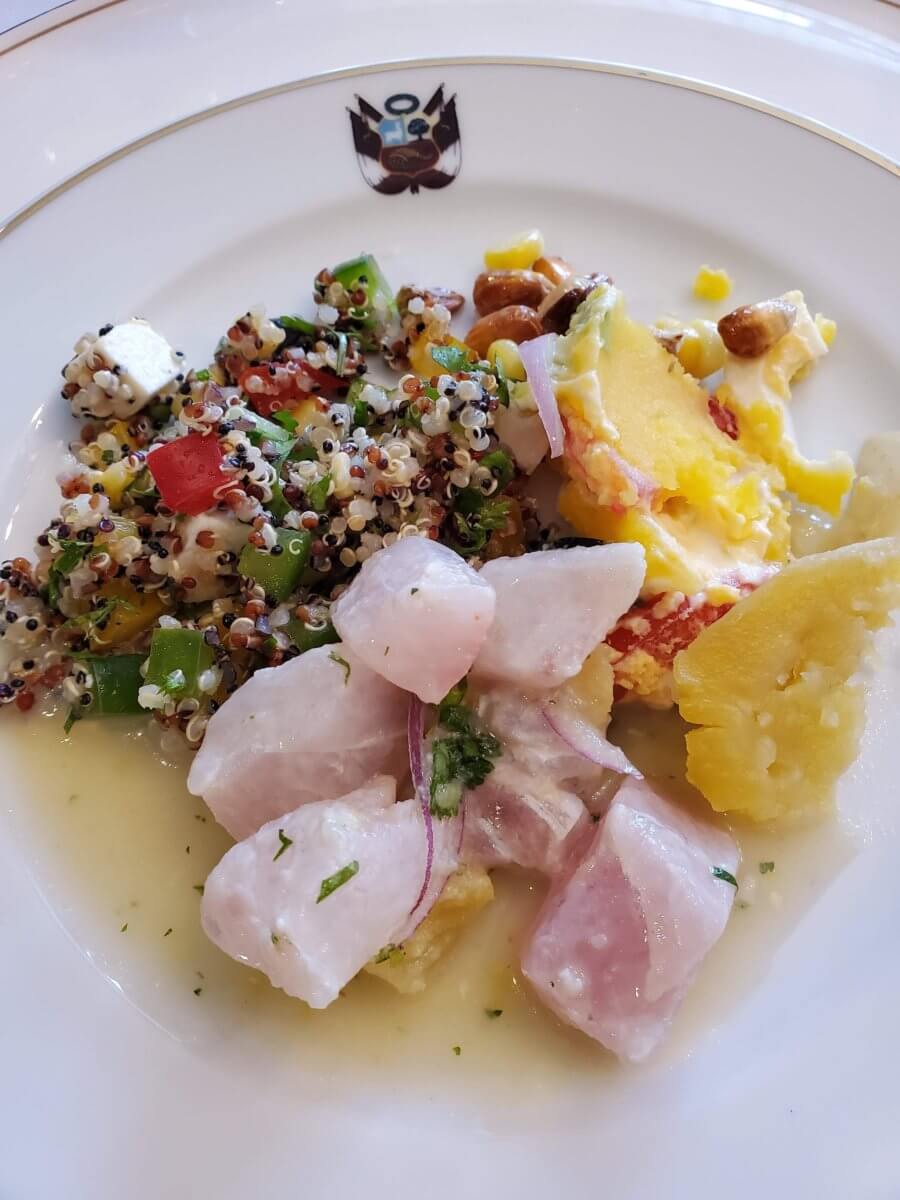
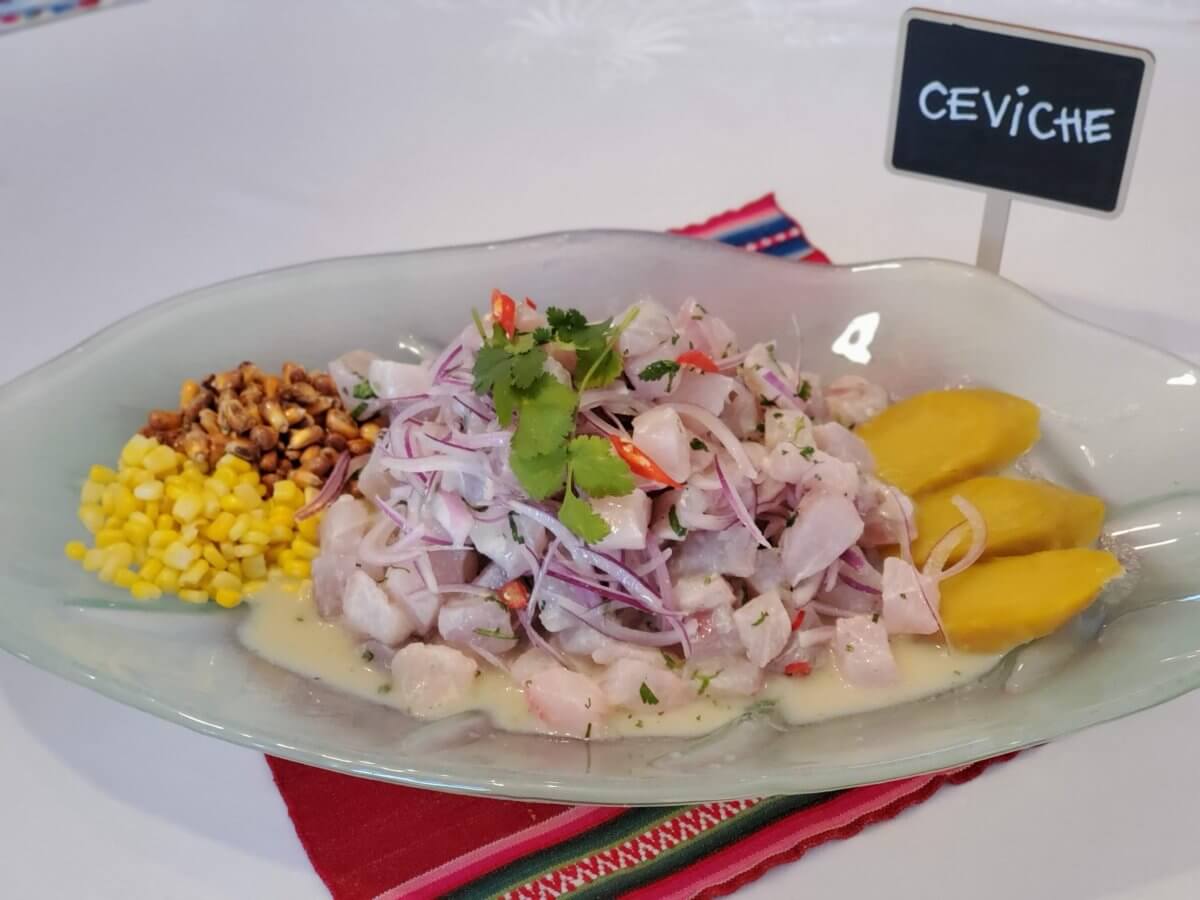
Ceviche is Peru’s national dish, which can be found almost in every restaurant there. There are lots of variations, but the original is sea bass soaked in lime juice, onion, salt and hot chillies. It is then served with a side dish of sweet potatoes and corn.

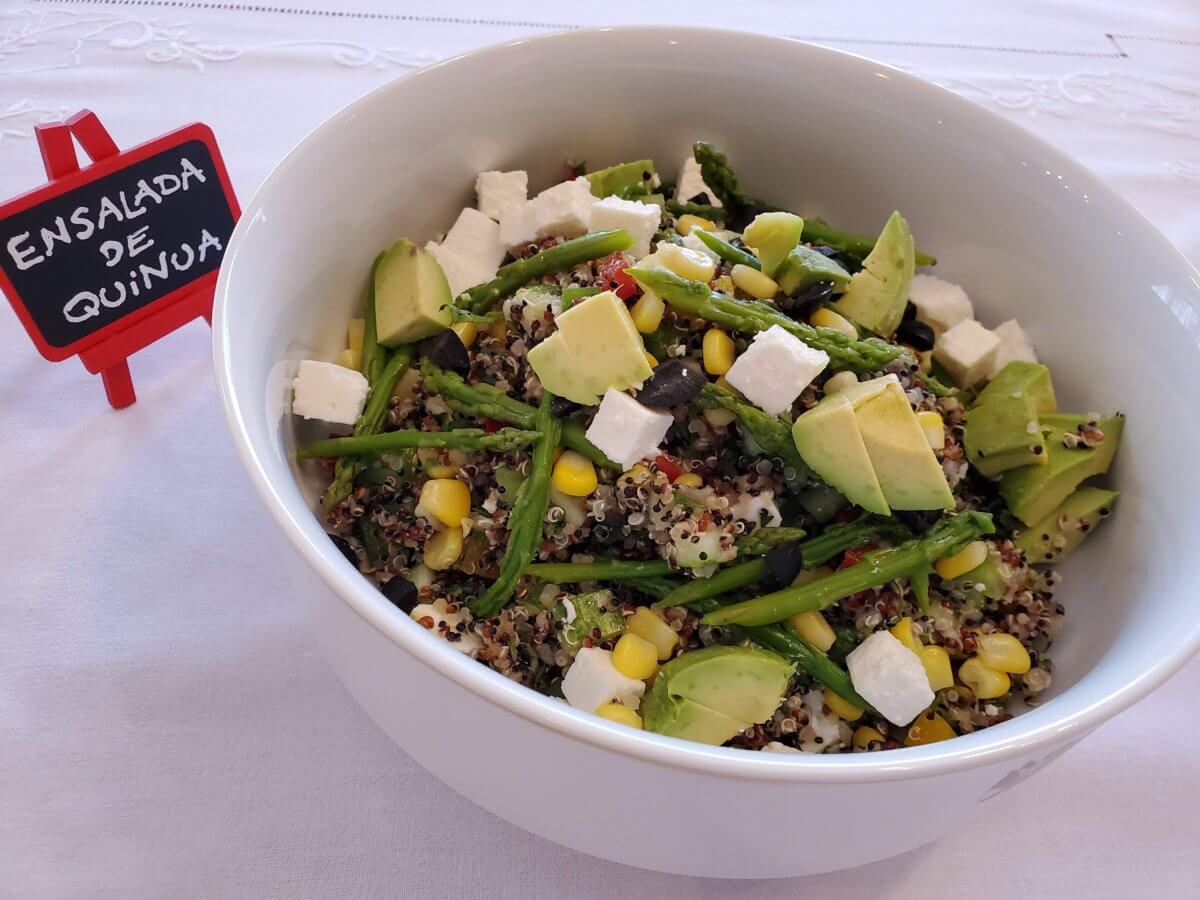
Peru is one of the most bio diverse places on earth, producing a vast variety of unique and nutritious foods. The most well known is the ancient Inca crop quinoa. Although often mistaken as a whole grain, it is in fact a pseudo-cereal, a seed that acts like a grain. Being a goosefoot, the plant itself is more like spinach and whole grains like wheat. It is often labelled as a superfood since it is not only gluten-free but also contains more protein, minerals, vitamins and fibre than many usual grains and seeds.

Flamed guinea pig has been a part of Peruvian traditional cuisine for around 5,000 years. The whole guinea pig is often barbecued or baked over an open fire, which creates smoky and crispy skin outside with juicy and tender meat inside. It is the staple meat of many households in the Andes while it seems unconventional to Western tourists who see this indigenous animal more as a domesticated pet.

Peruvian cuisine with its fusion of local and international flavours has gained a foothold in the global culinary scene. Although rooted in indigenous traditions, Peruvian cuisine has eagerly embraced influences from other cultures including European, African and Asian over the past several hundred years. The result is an exceptional fusion cuisine that reflects the nation’s multicultural history. 

As our interview draws to a close, Madame Ximena encouraged all readers to visit Peru, “Apart from Machu Picchu and our iconic scenery, please come and enjoy the pride and joy of South America, Peruvian cuisine.”

0 comment
1 FacebookTwitterPinterestEmail

Story by Kathleen Pokrud

Photo by The Embassy of Malaysia and Tourism Malaysia

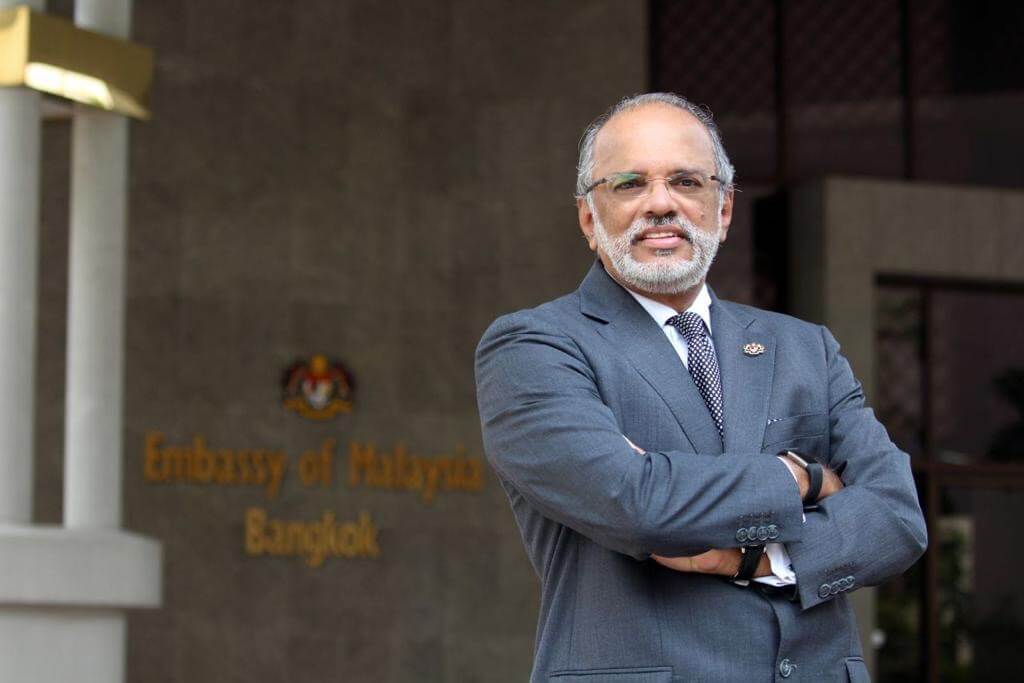
Foreword by Dato’ Jojie Samuel
Ambassador of Malaysia to Thailand

Once again, I would like to thank Ms. Kathleen for her initiative to help us to promote Malaysian culinary. Previously, an article about Peranakan food in Malaysia was published in Expat Life in Thailand. As a multiracial country, Malaysia’s colourful cultures are demonstrated through its food, including traditional and modern cuisines. 

Malaysian food is a mix of outstandingly delicious food and an affordable price tag to match, there is something for everyone. Eating out in Malaysia is a real gastronomic adventure. In Malaysia, eating is agreed to be a national passion for all Malaysians. Food has been a regular topic in conversation. I believe that there is no place that is more truly Asia than Malaysia, especially when it comes to food and travel. 

Needless to say, Malaysia is a beautiful and diverse country, which the food is a reflection of the many races that make up our country. From up north in Penang to down south in Malacca, you could explore the beautiful sights and even more delicious food at some of the best destinations Malaysia has to offer. Malaysia, Truly Asia indeed. 

Dear readers, I hope you enjoy reading this article. 

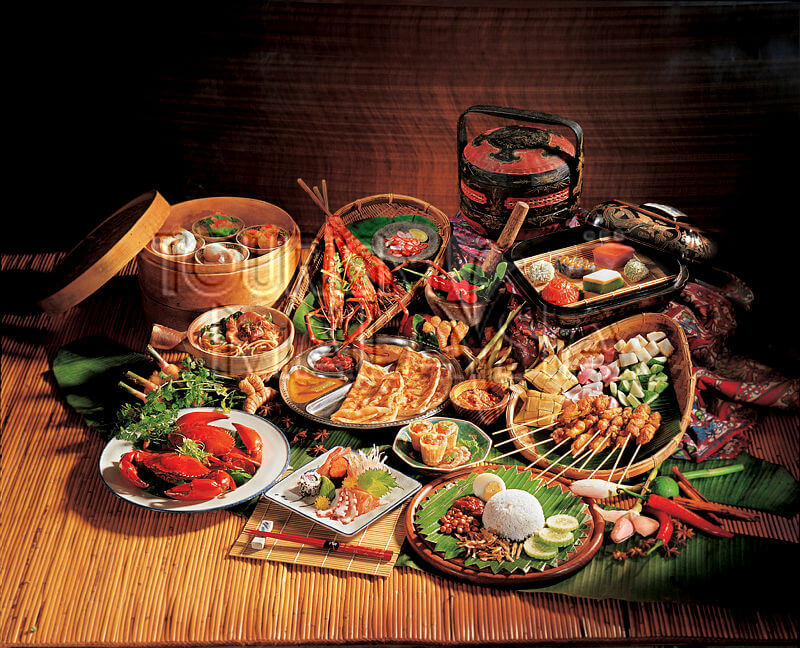
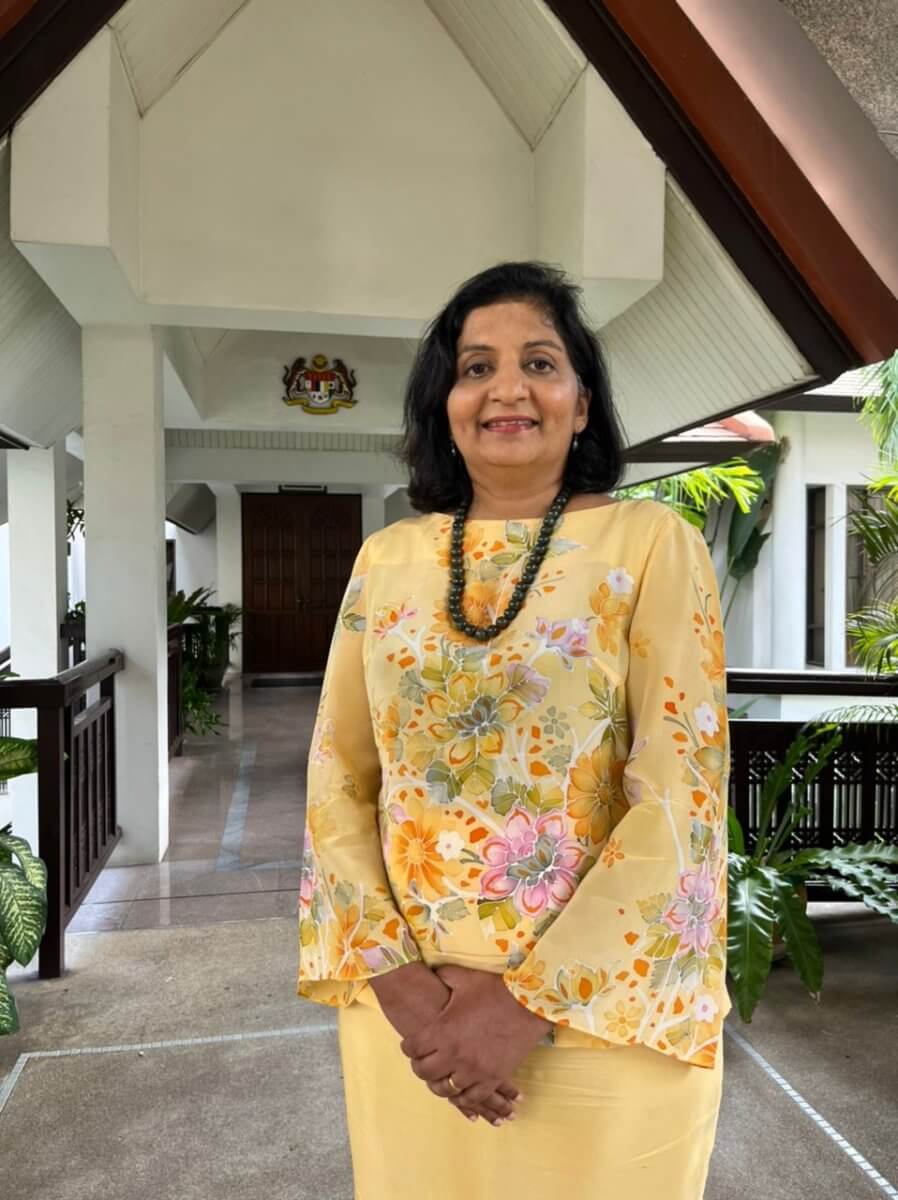
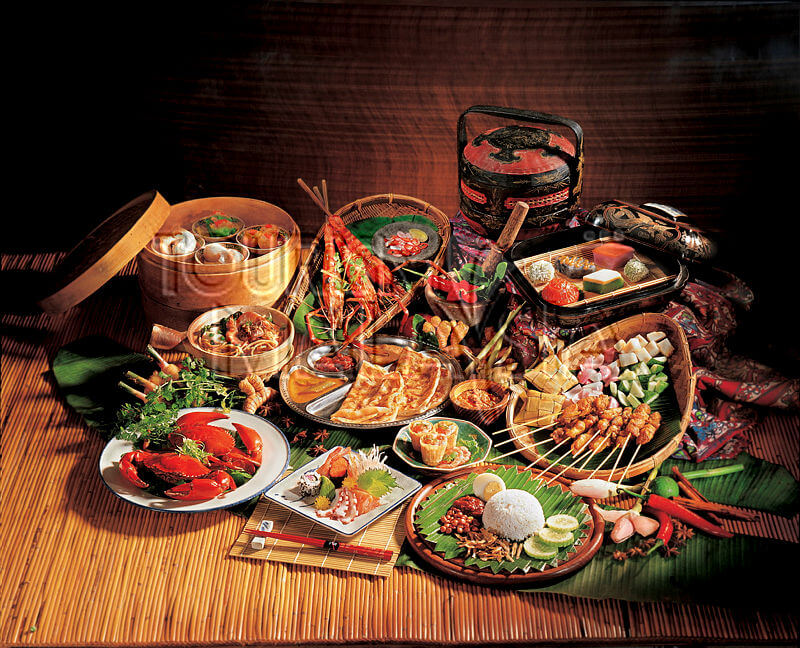
Malaysia is a country that celebrates its’ multiculturalism. This encourages the cultural diversity of Malaysian cuisine. Many culinary traditions coexist in Malaysia, such as Malay, Chinese and Indian. Similar to other countries, Malaysian food recipes are passed down through the generations and has evolved to suit modern day preferences and trends. The result is an array of enticing traditional favourites and modern offerings using a trove of local ingredients to suit multiracial palates. The term “Gastrodiplomacy” has been introduced to refer to how countries use their national cuisines to promote their countries. The Malaysian kitchen with their rich combination of spicy and flavourful cuisine is well placed to make Malaysia a food haven. I recently sat down with Datin Catherina Cherian Samuel, spouse of H.E. Dato’ Jojie Samuel, Malaysian Ambassador to the Kingdom of Thailand to learn how Malaysia is poised to be a gastronomical haven in Asia.

Malaysia as a country has brought together many different cultures. It is the heart of SE Asia. The food could be considered one of the most attractive and enjoyable experiences in Malaysia. I asked Datin Catherina what truly defines Malaysian Cuisine, “If there is one thing that unites all of us Malaysians; it is the love of good multicultural food that we have. Food has always been a vital part of the Malaysian identity. We pride ourselves on a variety of national dishes, which are consumed as a large portion of our regular diet. Malaysian cuisine includes Malay, Chinese and Indian food – a great mix of ingredients, techniques, and flavours. If you plan a trip to Malaysia, be sure to squeeze some time to explore the food. Also on the list of must try items are the food from East Malaysia which is located on the beautiful island of Borneo. The food there comprises of the bounties of the sea paired with locally grown grain, fruits and spices. Simple and fresh, the food in Borneo reflects the traditional knowledge of the natives of the land with influence from the Chinese and other immigrants who have called this mystical island their home for generations,

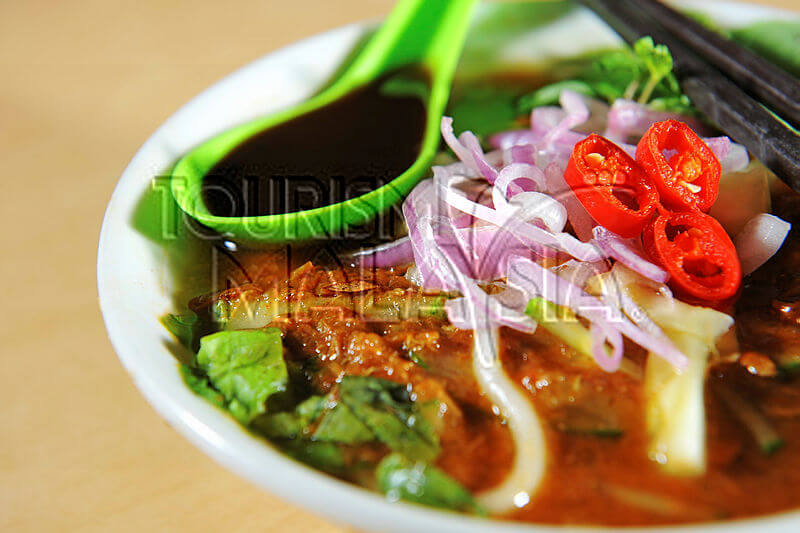
Catherina clarified further, “The food of Malaysia is known by the region they come from with each bearing its’ signature dish with unique taste and flavour. Some such favourites are satay with peanut sauce, asam pedas, kolok mee, nasi dagang, laksa and fish head curry. Rice and rice based noodles are the staples in Malaysian cuisine. As it is the norm in Asia, rice is usually eaten together with meat and vegetable dishes, curries and condiments. Malay food liberally incorporates aromatic spices such as cinnamon, coriander seeds, star anise, turmeric, nutmeg and candlenuts. Coconut is used in many dishes – rice, savouries and desserts. What gives the mouthwatering delicacies a distinct flavour is the skilful use of herbs such as lemongrass, ginger, galangal and leaves of turmeric, pandan and kaffir lime plants, In the northern states of Malaysia, the influence of Thai is evident in the preference for sticky rice, sweet desserts and mango incorporated in local dishes. In the east coastal states of Malaysia where fish is plentiful, keropok (fish snacks) are sought after by all.

On the subject on how Malaysian cuisine has evolved over the years, Datin Catherina explained, “The story of Malaysian food is part of the nation’s history, of course. From around the 12th century, the Straits of Malacca provided an important and busy travel route for merchants from China, India, the Middle East and Europe. They traded and exchanged their wares in the area that is now known as Melaka (Malacca) and Pulau Pinang (Penang). In the 15th century, Hang Li Po, a Chinese princess was sent to marry a Malaccan Sultan in an effort to strengthen relations between the two countries. The princess brought along an entourage of Chinese who settled in Malacca. These early Chinese settlers along with the Chinese merchants who plied that trade route ended up marrying local women and settling namely in Penang, Malacca and Singapore which later came to be known as the Straits Settlements. The Straits Settlements was the name given during the British rule from 1824 - 1957.

The British also attracted Chinese migrants to work in the tin mines of that era and to conduct business in the commodities such as rubber and spices. The early Chinese settlers contributed significantly to the prosperity and culture of these states. The food of the Chinese in the Straits Settlements is known as Peranakan food. They are delightful concoctions of Chinese food which include local spices and flavours, a testimony of how the early Chinese settlers had assimilated with the locals in the new country. Non Peranakan Chinese food has influenced Malaysian cooking through the wide use of garlic, ginger, rice wine, sesame oil and soy sauce.

As mentioned earlier, the fact that the fact that the Straits of Melaka was an important commercial route did not go unnoticed. In the 15th century, the Portugese invaded Melaka with the intention to monopolise the spice trade and spread Christianity. The Portugese too, influenced the food in Malaysia. There exists today the Portuguese settlement in Melaka which boasts of the food of their ancestors that has evolved to satisfy the tastebuds of their Malaysian descendants. Portugese devil curry, fish dishes and cakes are what we enjoy in Melaka. Following the Portuguese, the Dutch and the British colonial masters also influenced the food in Malaysia, namely in the Eurasian communities who make it a point to serve their traditional delicacies alongside rice and spicy curries!

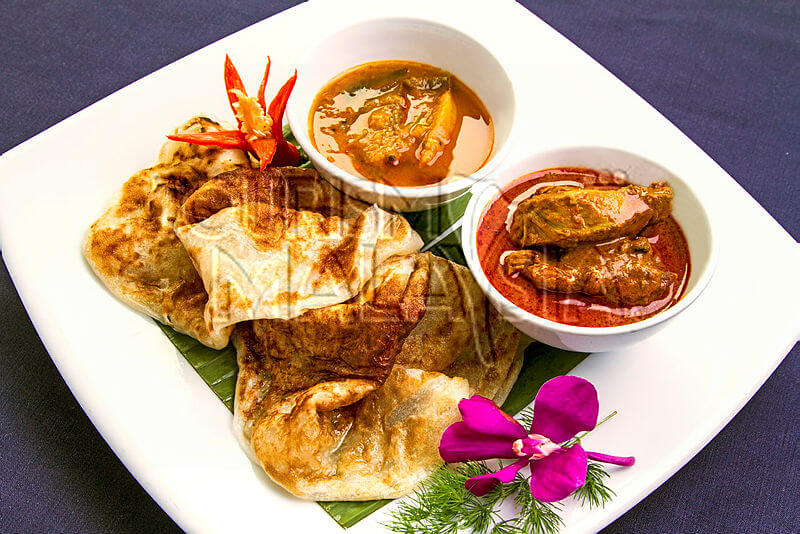
Apart from the early Indian traders who settled in the Northern States of Penang and Kedah, the majority of the Indians and Sri Lankans currently residing in Malaysia are descendants of the people brought into the country by the British. A large number were brought in to work in the rubber plantations and the railways in the 19th century. A smaller group of educated Indians were later brought in to work in the local medical, educational and civil services established by the British. The Indians brought with them a noteworthy influence on local cuisine with curries, biryanis, roti’s and snacks such as murukku which are served at all festive occasions regardless of ethnicity.

Datin Catherina commented frankly, “I would say Malaysian cuisine deserves more global recognition than it currently has. It is not as well known as Thai, Korean and Japanese cuisine. Nonetheless, I believe that, real food enthusiasts will appreciate the true flavours and at the end of the day our cuisine always stand out among the ‘foodies’. You have not truly experienced Malaysian cuisine until you thrill your taste buds with all the good food we have to offer.”

There are Malaysian restaurants in major countries around the world. One such popular restaurant is the Papparich restaurant that serves Malaysian favourites such as Nasi Lemak and Chicken Rice in Australia, Singapore, Brunei and in the US. In addition, we are proud of the Reunion Malaysian Café and Kitchen in Washington DC that has grown significantly since its opening, serving Nasi Lemak, Nyonya Laksa and durian crepes to homesick Malaysians and gourmet eaters in the US. In addition, we have Malaysians who are very passionate about introducing the world to the rich flavours of Malaysian cuisine. Food experts like Chef Wan, Malaysia’s celebrity chef and Ping Coombes, the past winner of MasterChef UK are prominent figures. We are very grateful to have them promoting Malaysia cuisine abroad. 

As it is with other countries, Malaysia’s food culture or trends must have changed quite significantly over time. Datin Catherina explained, “The Covid 19 pandemic has caused a drastic change in the lifestyles of Malaysians since early 2020, and this also meant a big change for the Malaysian diet too. It has  become quite obvious that Malaysians are increasingly driven by health concerns and want their food to contribute to strong and healthy bodies. We are seeing a trend towards healthier eating. Malaysians are  more conscious about their food consumption; hence healthy eating will continue to be a huge part of food trends.”

She elaborated further, “Given the fact that most urbanites have very little time to cook on a daily basis, the eateries offer pick-and-go food where such wraps, sandwiches or poke bowls on their way back from work or even during busy lunch hours. Malaysians are also known for their ”Mamak restaurant culture” and it is especially popular among the young adults. These are Indian Muslim eateries that offer fast service at reasonable prices. Best of all, they are open 24 hours a day,  making them an easy and convenient choice for people from all walks of life.

Preserving the traditional Malaysian cuisine and local favourites are important to us because they are part of our heritage, “With the new generation living a fast paced life and being more health conscious, traditional and laborious methods of preparing food need to be reconsidered. The challenges are to maintain the original taste of food whilst taking cognisance of the need to incorporate healthy cooking methods and minimising cooking time. As we are aware, food and tourism go hand in hand. Other than sightseeing, islands and beaches, the food offered has brought many visitors to our tropical paradise.

According to Datin Catherina, “The authorities such as Tourism Malaysia and Malaysian External Trade Development Corporation (MATRADE) have organised events around the world promoting traditional Malaysian food as an attraction to tourists. 

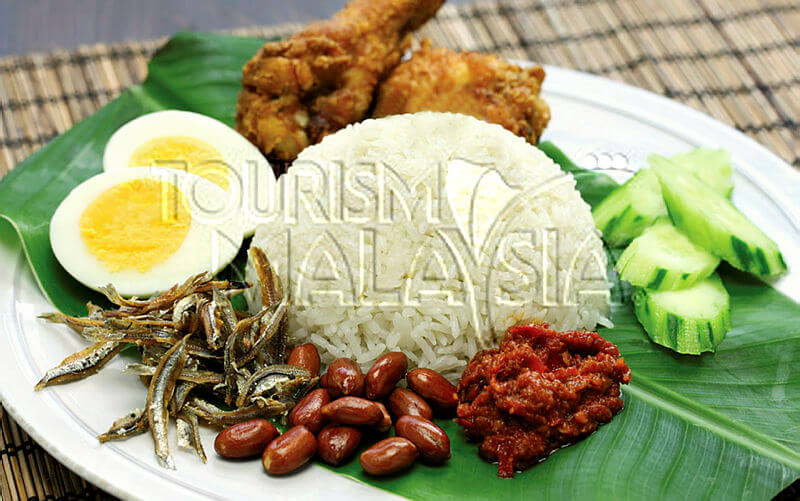
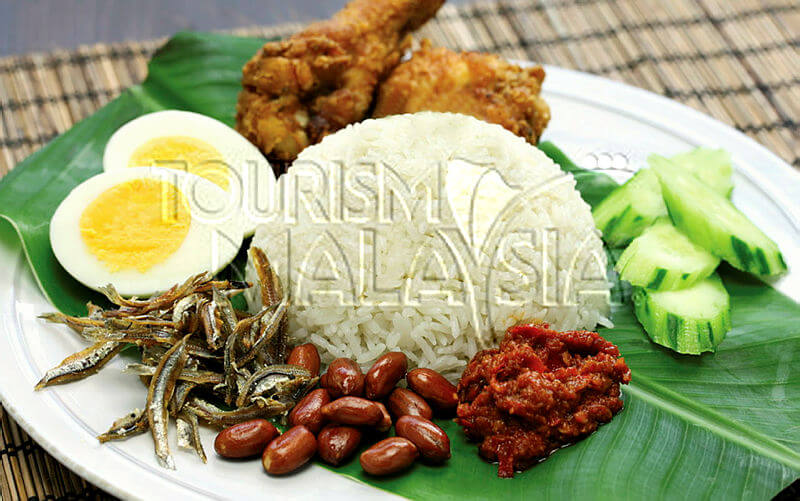
Nasi Lemak: National dish of Malaysia

In Malaysia, Nasi Lemak is what we would call comfort food. You can find Nasi Lemak in almost any eatery, be it at street vendors, restaurants and hotels. This humble dish comprising of coconut infused rice served with a spicy anchovies sauce has grown to include a long list of accompaniments. The most popular one is chicken and beef rendang. These chicken and beef dishes were, in the past, reserved for festive occasions. Comprising of meat slow cooked with aromatic herbs, spices and large quantities of coconut milk, it has found its way to the heart of locals and foreigners alike. 

As our interview draws to a close, I agree with Datin Catherina, “Malaysian food has similarities with those of its neighbouring countries such as Thailand, Indonesia, Brunei and Singapore as we use similar raw ingredients which are found abundantly in this region. However, in terms of tastes and flavours, cooking techniques and preparation methods our food differs. To the discriminating palate, Malaysia is a food haven not to be missed!

0 comment
0 FacebookTwitterPinterestEmail
Newer Posts